ENEnglish
 LTLietuviškai
 DEDeutsch
 FRFrançais
 RUРусский
 ESEspañol
 PLPolski
 ITItaliano
 UKУкраїнська
 CSČeština
 PTPortuguês
 JA日本語
JA日本語 LVLatviešu valoda
 ETEesti
 HUMagyar
 IDBahasa Indonesia
 TRTürkçe
 HIहिन्दी
 ELΕλληνικά
 ARالعربية
 THไทย
THไทย VITiếng Việt
 RORomână
 MSBahasa Melayu
 BNবাংলা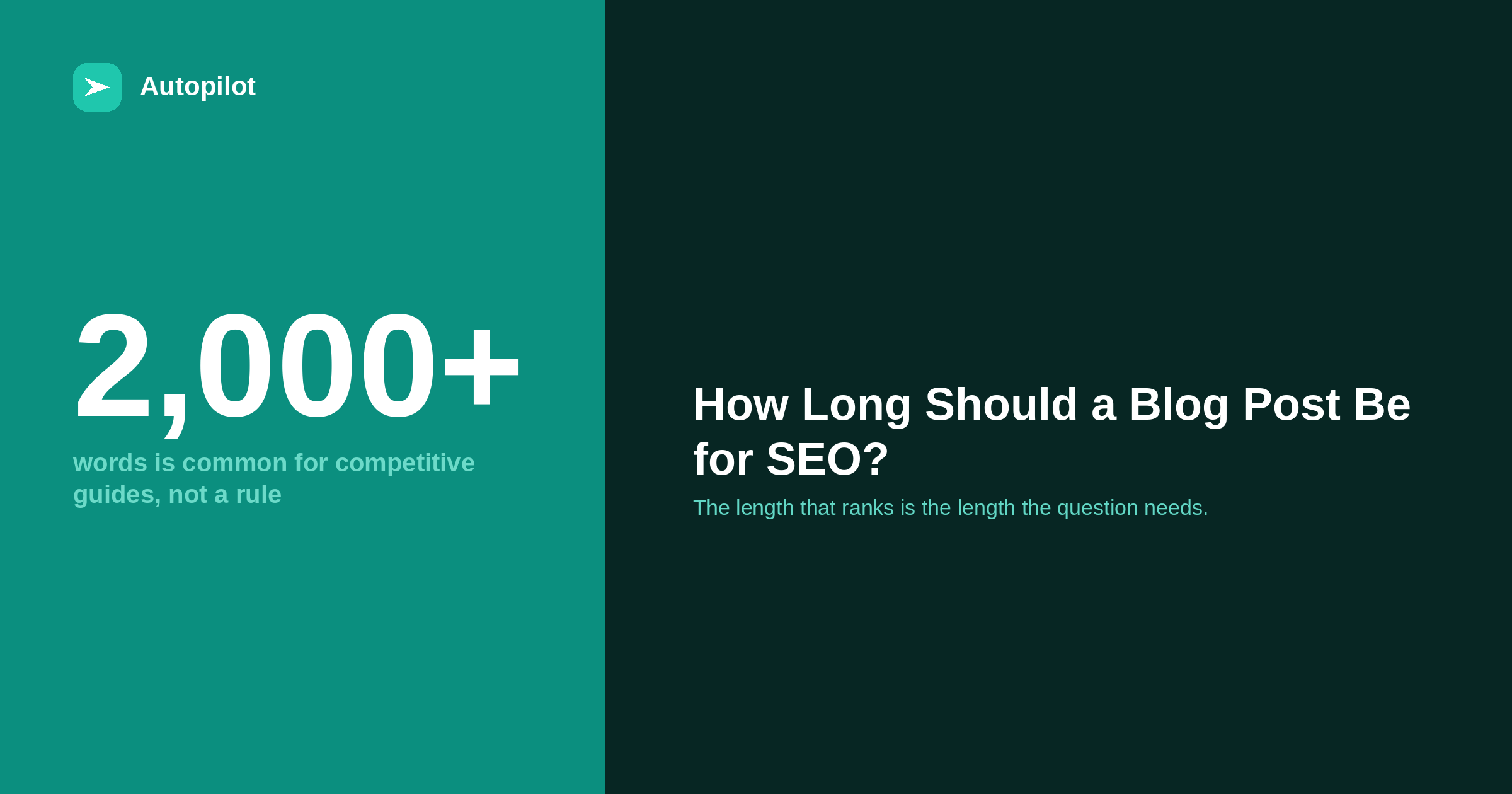
Short answer: there is no ranking threshold for word count, and any specific number you have been given is a description of what already ranks rather than a requirement. Length should follow the question: a definition needs a few hundred words, a comparison needs room for a table and an FAQ, and a genuine how-to guide often runs past two thousand because the task has that many steps. The useful test is whether every section answers something a reader actually asked; when it stops doing that, the article is finished.
The word-count question refuses to die because it is comforting. A number is easy to hit, easy to brief and easy to check, and it feels like progress. What it is not is a ranking factor.
Search engines do not measure length directly. What they measure, indirectly, is whether a page satisfies the query — and depth correlates with satisfaction for some questions and not others. That correlation is where every "2,000 words minimum" rule came from, and it is why those rules produce padded articles when applied to the wrong query.
Why long articles often rank anyway
If length is not a factor, why does the first page look like it is? Three reasons, none of them word count itself.
Competitive queries attract effort. The queries worth ranking for are contested, and contested pages get more work put into them. Depth is a symptom of that effort.
Complex questions need space. "How to set up X" has steps, exceptions and failure modes. Covering them honestly takes room; cutting them to hit a shorter target means leaving the reader stuck at step four.
Longer pages accumulate more. A thorough article naturally collects more sub-questions, more internal links and more reasons for someone else to link to it. Those are real ranking inputs. Length is their side effect.
What different query types actually need
Start from the question rather than from a target, and the length decides itself.
| Query type | Example | Typical useful length | What it must contain |
|---|---|---|---|
| Definition | what is an RSS feed | 300–700 words | A direct answer in the first paragraph |
| Quick how-to | how to add alt text | 500–1,000 words | Numbered steps and one screenshot’s worth of detail |
| Comparison | tool A vs tool B | 1,200–2,000 words | A table, and an honest note on where each wins |
| Full guide | how to automate a blog | 2,000–3,000 words | Sections per sub-question, plus an FAQ |
| Reference | list of X for Y | Varies with the list | Completeness, not prose |
Notice that the right-hand column, not the length column, is what does the work. If you can write the right-hand column honestly in half the words, the article is better for it.
When more words start hurting
Length becomes a liability at a predictable point: when a section exists to reach a target rather than to answer something.
- The history section nobody asked for. "The origins of email marketing date back to…" in an article about subject lines.
- Restating the introduction as a conclusion. Two paragraphs saying what the article already said.
- Synonym padding. Three ways of expressing one idea so the section looks substantial.
- The everything article. One page trying to cover a topic that should be four pages, each ranking for its own query.
Each of these pushes the actual answer further down the page, which is measurable in how quickly readers leave. That is a real signal, and padding makes it worse.
How to decide length before you write
A brief that says "about 2,000 words" produces padding. A brief that lists the questions produces the right length by itself. Before writing, put the query into a search engine and read what the first five results actually cover — not how long they are, but which sub-questions they answer and which they skip. The gaps are your article.
Then write the list down. Six sub-questions with real answers will land somewhere around 1,500 to 2,000 words without anyone aiming at it. Two sub-questions will land at 600, and that is the correct answer for that query rather than a failure to hit a target.
One practical check before publishing: read only the headings. If the sequence of headings reads like a sensible answer to the query on its own, the structure is right and the length follows. If two headings say roughly the same thing, one of them is padding.
A simple structure that scales with the question
The same skeleton works at 600 words and at 2,500, which is what makes it useful:
- A direct answer first. One paragraph that would satisfy someone who reads nothing else.
- One section per sub-question. Not per keyword — per thing a reader would ask next.
- A table when you are comparing. Comparisons in prose are hard to use.
- An FAQ for the leftovers. The questions that deserve an answer but not a section.
- Stop. When the sub-questions run out, the article is done.
Applied honestly, this produces short articles for simple questions and long ones for complex ones, without anyone counting words. Autopilot writes to this shape and caps articles at 3,000 words, which is long enough for a full guide and short enough to stay readable; more on how the structure works across a whole blog is on the blog.
Related reading
- Why Your Blog Posts Aren’t Ranking: Eight Real Causes
- How Long Before a New Blog Post Ranks?
- How to Find the Content Gaps Your Blog Has
The bottom line
Stop briefing by word count and start briefing by question. Write down what a reader must know by the end, give each item its own section, add a table where you are comparing and an FAQ for the remainder, then stop when the list is exhausted. The length you arrive at is the right one for that query, and it will change from article to article — which is exactly what a blog that answers real questions looks like.
FAQ
Is there a minimum word count for ranking?
No. Search engines do not apply a length threshold. Short pages rank for short questions every day, and the shortest satisfying answer often wins the featured snippet.
Why do SEO tools recommend a word count?
They average the pages currently ranking for the query. That is a description of the competition, which is useful context, not a target to hit with padding.
Should I lengthen an old article that is not ranking?
Only if it is incomplete. If readers still leave with an unanswered question, add that answer. If the article is complete, the problem is elsewhere — usually the angle or the competition.
Do long articles work for AI answer engines?
What works is a clear, self-contained answer near the top and well-labelled sections below it. Length helps only insofar as it lets you cover more questions clearly.
Is it better to split a long article into several?
If each part answers a different query, yes. If they answer the same query, splitting creates two pages that compete with each other and neither wins.
How long should the introduction be?
Short. A reader who has just searched wants the answer, not context. One or two paragraphs, with the direct answer inside the first of them.