ENEnglish
 LTLietuviškai
 DEDeutsch
 FRFrançais
 RUРусский
 ESEspañol
 PLPolski
 ITItaliano
 UKУкраїнська
 CSČeština
 PTPortuguês
 JA日本語
 LVLatviešu valoda
 ETEesti
 HUMagyar
 IDBahasa Indonesia
 TRTürkçe
 HIहिन्दी
 ELΕλληνικά
 ARالعربية
 THไทย
 VITiếng Việt
 RORomână
 MSBahasa Melayu
 BNবাংলা
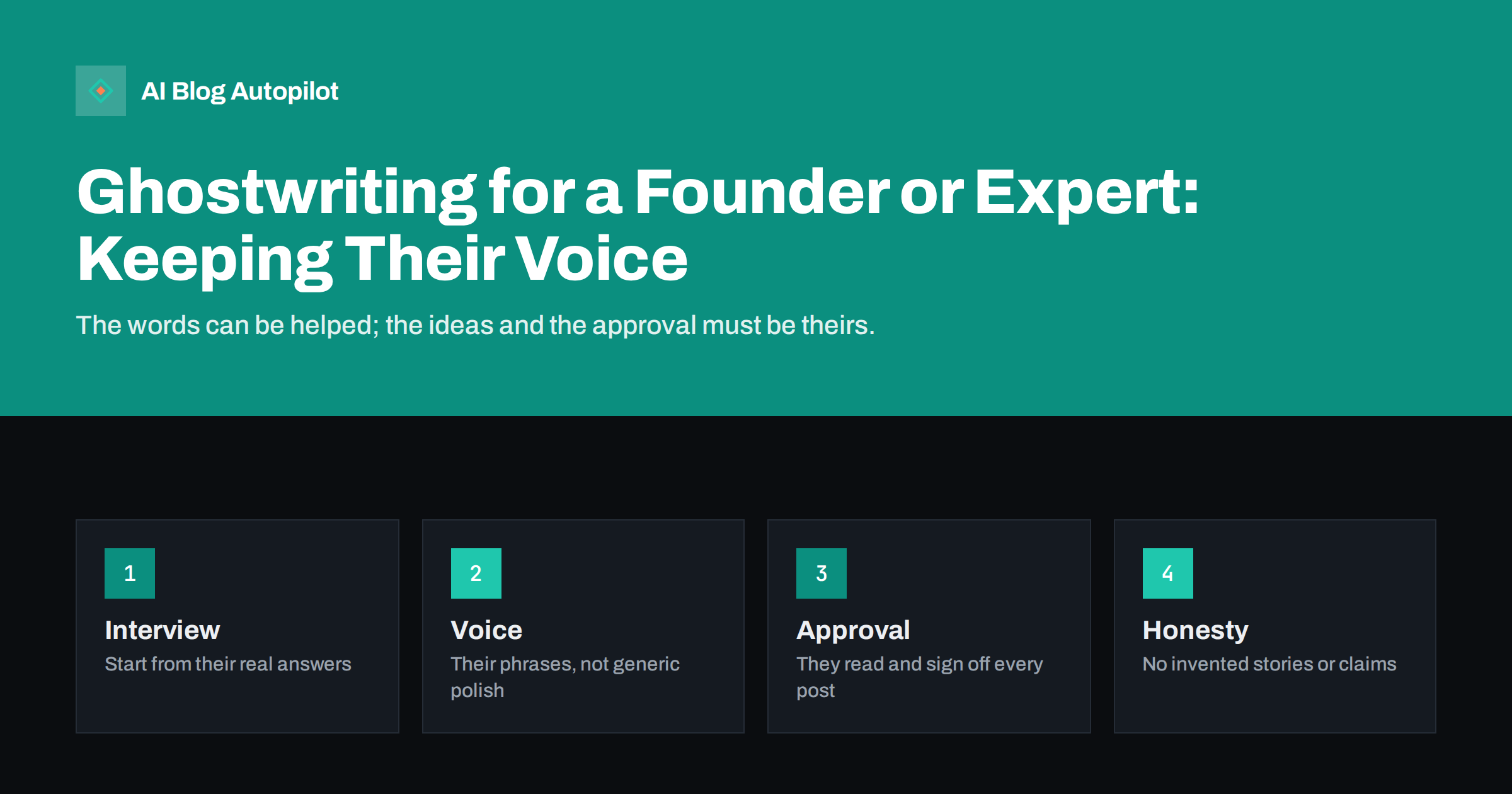
Short answer: ghostwriting for a founder or expert works when the ideas, facts and stories come from them and the writer or tool only shapes the text. Interview them, collect real examples, write in their natural phrases, have them approve every post and never invent experience or quotes. Be open in your policies about how posts are produced, and keep their name only on what they truly stand behind.
Founders and specialists are often the best voices for a business blog, and the people with the least time to write. Readers and search engines value first-hand experience, so a post that carries a real person’s knowledge and opinions is worth more than a generic article. A ghostwriting process lets that knowledge reach the page without taking hours out of the expert’s week, provided that it is built on honesty and consent.
Agree what ghostwriting means
Begin with a clear agreement. The expert supplies the ideas, the facts, the stories and the final approval, and the writer organises, edits and polishes. This is a long and ordinary practice in business writing, as with speeches and books. It becomes a problem only when the content claims experience the named person does not have, or when it is presented in a way that misleads readers about who wrote it.
Decide how you will describe the arrangement. Some businesses write “by” the expert and describe in their editorial policy how drafts are prepared with help and reviewed by the named person. Others use a byline such as “written with” or the name of the team. Choose what is true and consistent, and explain it on a policy page, as in writing an editorial policy page.
Agree the limits: topics the person will not discuss, claims that must always be checked, the clients or partners who may not be named and the time allowed for review. Writing these down saves difficult conversations later.
Prepare for the interview. Read the person’s recent posts, check the questions customers have asked this month and bring a short list of topics with two or three questions for each. Begin with the topic they know best and care about, since enthusiasm shows in the answers. End by asking what they wish people understood, which often produces the most useful and honest sentences.
Start with an interview, not a blank page
The best ghostwritten posts start with a conversation. Ask the expert the questions a customer would ask: what do people get wrong, what would you do differently, what happened last month that taught you something? Record the call, with consent, and keep the transcript. Our guide to turning voice notes and meetings into blog drafts shows how to do it efficiently.
Ask for specifics: numbers, names where allowed, dates, places, mistakes and the reasoning behind a decision. General statements are easy to write and forgettable, while concrete detail is what makes a post credible. Push gently for the story behind each opinion, and for the exception that a careless writer would miss.
Collect other material the person already has: emails to customers, answers in meetings, slides, notes and social posts. These show how they actually speak and what they care about. They are also a source of facts that can be checked, which helps avoid errors in the draft.
Read the draft aloud before sending it. A sentence that is hard to say is usually hard to read, and a phrase that the person would never use will stand out at once. Replace formal words with the ones they use in conversation, and cut the filler that automated drafting tends to add. Our guide on AI filler phrases to cut lists the most common ones.
Capture the voice without caricature
Voice is made of rhythm, vocabulary and attitude. Read several things the person has written or said, and note the length of their sentences, whether they use humour, which words they favour and which they avoid. Describe the voice in a short guide, with a few examples of sentences that sound like them and a few that do not. Our guide to brand voice guidelines for AI content shows how to write one.
Do not overdo it. A caricature that repeats catchphrases in every paragraph sounds false. Aim for a text that the person reads and says, “yes, that is how I would say it”. Let the guide change over time, and update it with their corrections.
Use “I” and “we” consistently and appropriately, as discussed in choosing between we and I. If the post speaks in the first person, every statement in it must be something the person could honestly say.
Never invent experience, quotes or numbers
The most serious risk of ghostwriting is fabrication. A writer or an AI tool may add a pleasant anecdote, a statistic or a quote to make a paragraph flow, and the expert may approve without noticing. Treat every first-person story as a claim that must be confirmed. If the expert did not say it or do it, it does not go in.
Mark anything uncertain in the draft so that it is reviewed: “check: did this happen in 2023?” Ask the person to confirm names, dates and figures, and keep their confirmation. Our guide to fact-checking AI content offers a routine that works equally well for human drafts.
Be careful with opinions as well. A founder may hold a view privately and prefer not to publish it, or may hold a view that changes. Do not put words in their mouth to make a post more provocative. A cautious, accurate post is better than a bold one the person disowns the next day.
Give the reviewer a short checklist: are the facts right, are the stories true, is anything missing and is there anything you would rather not say publicly? Four questions are quick to answer and catch most problems. Store the answers with the draft so that you can show later how the post was checked.
Build a light approval routine
Experts are busy, so make review easy. Send a short draft with the key claims highlighted, ask three questions at most and give a deadline that respects their schedule. A mobile-friendly format, a short audio summary or a call of ten minutes often works better than a long document.
Keep the approval record: who approved which version and when. If the person edits, apply the edits and do not argue about style unless accuracy is at stake. Over time you will learn what they always change, and the drafts will need fewer corrections.
If the person does not respond, do not publish in their name. Delay the post, or publish it under the company’s name. Treat silence as no approval, and let the schedule slip rather than risk a statement they did not make. Our guide to draft, approve or full auto compares the options.
Keep the person’s profile page current. Add their role, areas of experience, speaking or publishing history and a recent photograph, and link it from every post they have approved. If their role changes or they leave, update or retire the profile and add a note to older posts where it matters. Readers who click through will judge the post by what they find there.
Be honest with readers and with search engines
Show the person’s name, role and a short bio, with a link to a page that describes their experience. This supports the signals of expertise and trust that search engines and readers look for, as described in author bios and bylines. The bio must be truthful, and any credentials must be verifiable.
Describe your process in one place. Say that posts are prepared from interviews and notes with the help of editors and tools and are reviewed and approved by the named person, if that is the case. This is not an admission of weakness; it is the kind of clear practice that readers appreciate, and it matches the advice in disclosure of AI use.
Do not create fictional experts. A named author who does not exist is deceptive, however good the content, and it is easy to disprove. If nobody on the team wants to be named, publish under the company name and let the quality of the writing speak.
Plan the schedule with the expert’s time in mind. One interview of forty minutes can produce material for several posts, and a quarterly session can supply a whole season of topics. Our guide to planning a quarter of content in one afternoon shows how to turn one conversation into a calendar of posts.
Make the voice last across many posts
Keep a shared document of the person’s stories, favourite examples, phrases, opinions and things they dislike, and add to it after every interview. It becomes a source for later posts and ensures consistency. A new writer can read it and understand the voice quickly.
Review a sample of past posts every few months with the expert. Ask which they like, which sound wrong and what they would say differently now. Their views change, and the voice should change with them. Retire older statements that no longer represent them, using the approach in how to refresh old blog posts.
How AI Blog Autopilot helps
AI Blog Autopilot writes full SEO articles for your WordPress blog from the topics, keywords, audience and tone you set, with FAQ sections, tags and SEO meta included, and it shares each one to your social networks. You set the tone and audience, and approval mode lets you or your expert read each article first, which matters for first-person claims and names. See the pricing page for plans.
Related reading
- Author Bios and Bylines That Build Trust
- Interviewing Experts for Content People Trust
- Brand Voice Guidelines for AI-Assisted Content
The bottom line
Start from the expert’s real answers, write in their natural voice, never invent experience, get approval for every post, and be open about how posts are produced and who stands behind them.
FAQ
Is ghostwriting a blog honest?
Yes, if the ideas and facts come from the named person, they approve the post and your policies describe the process truthfully.
How do I keep a founder’s voice?
Interview them, read what they write and say, keep a short voice guide and let them correct drafts.
What if the expert is too busy to review?
Do not publish in their name without approval. Delay the post or publish under the company name.
Can an AI tool help?
It can help with structure and wording, but every story, claim and quote must come from the person and be checked.
Should the post name the writer?
A byline such as “written with” or an editorial policy that explains the process is more honest than implying sole authorship.