ENEnglish
 LTLietuviškai
 DEDeutsch
 FRFrançais
 RUРусский
 ESEspañol
 PLPolski
 ITItaliano
 UKУкраїнська
 CSČeština
 PTPortuguês
 JA日本語
JA日本語 LVLatviešu valoda
 ETEesti
 HUMagyar
 IDBahasa Indonesia
 TRTürkçe
 HIहिन्दी
 ELΕλληνικά
 ARالعربية
 THไทย
THไทย VITiếng Việt
 RORomână
 MSBahasa Melayu
 BNবাংলা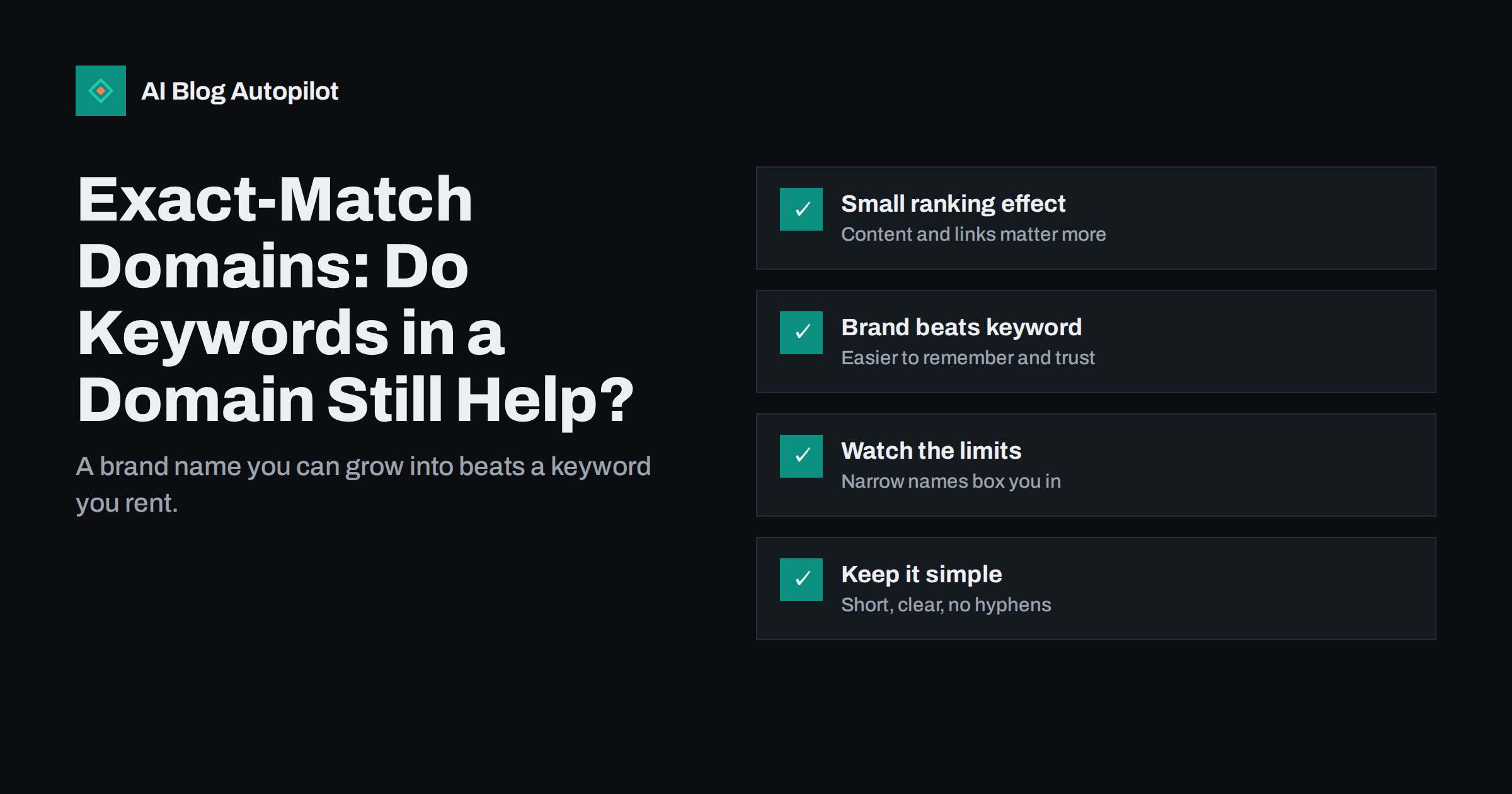
Short answer: a keyword in your domain name gives little or no direct ranking advantage today. Search engines rank pages on how well they answer a query, how trustworthy the site is and how others refer to it, not on whether the domain repeats the search term. An exact-match domain can still help a little with click-through and clarity, but it also limits your future topics and can look spammy. For most blogs, a short, memorable brand name is the better long-term choice.
An exact-match domain (often shortened to EMD) is a domain name that matches a search phrase word for word, such as bestrunningshoes.com for “best running shoes”. A partial-match domain contains the keyword plus something else, such as runningshoeslab.com. For years, both were treated as an SEO shortcut. Domain investors paid high prices for them, and many small sites were launched on a keyword domain with thin content, hoping the name alone would carry them up the results. That shortcut mostly disappeared long ago, but the question still comes up every time someone starts a new blog.
Where the idea came from
In the early years of web search, the words in a domain name were one of the easier signals for a search engine to read. Links pointing to a site often used the domain name as anchor text, so a keyword domain collected keyword-rich anchors automatically. The combination made exact-match domains rank surprisingly well, even when the content behind them was weak.
In 2012 Google announced an update aimed specifically at low-quality exact-match domains. The point was not to punish every site with a descriptive name. It was to stop weak sites from ranking just because their domain matched a query. Since then, search systems have become far better at understanding what a page is about from its content, structure and context, so the name of the domain has become a minor detail rather than a lever.
Representatives of Google have repeatedly said in public that you do not need keywords in a domain name to rank for those keywords. Large sites that rank for almost everything, from encyclopedias to marketplaces, have brand names that say nothing about the topic.
What a keyword domain can still do
That does not mean a descriptive domain is worthless. It can still offer some practical, indirect benefits:
- Clarity in search results. A searcher who sees a domain that matches their need may be slightly more likely to click, especially when the site is unknown.
- Natural anchor text. When people link to the site using its name, the name happens to describe the topic.
- Instant positioning. A reader who sees the domain on a business card, in a podcast or on social media understands the subject immediately.
- Easier recall for generic topics. For a very narrow, stable subject, a plain descriptive name can be easy to remember.
These are effects on people, not a ranking bonus. And each of them can be achieved by a good brand name combined with a clear title tag, a strong homepage and a consistent description of what the blog covers.
The downsides of exact-match domains
Keyword domains come with costs that are easy to underestimate when you are excited about a new project.
- They box in your topics. A blog called cheapflightstoparis.com struggles the day you want to write about Rome, hotels or train travel. A business that grows beyond the original keyword often ends up changing its domain, which is a project with real risk.
- They look generic. Many readers associate long keyword domains with low-quality affiliate sites. That can reduce trust, which matters more than any small click-through benefit.
- They are hard to protect as a brand. A purely descriptive name is difficult to register as a trademark, and competitors can choose almost identical names.
- They invite over-optimisation. When the domain, title, headings and anchors all repeat the same phrase, the site can start to look engineered for search rather than written for readers.
- They are expensive. Good exact-match .com names in commercial niches are usually already owned and sold at premium prices, money that would do more as content.
There is also an emotional trap. Owners who paid a lot for a keyword domain sometimes expect it to rank by itself and invest less in content. The domain then becomes an excuse for a thin site, which is exactly the pattern search engines learned to ignore.
Exact-match, partial-match or brand: a comparison
| Domain type | Example | Strengths | Weaknesses |
|---|---|---|---|
| Exact-match | bestrunningshoes.com | Instantly descriptive | Narrow, generic, little ranking value, hard to brand |
| Partial-match | runningshoeslab.com | Descriptive with some identity | Still tied to one topic, can sound like an affiliate site |
| Brandable | stridelab.com | Memorable, flexible, easier to protect | Needs content and a clear tagline to explain the topic |
| Personal or company name | janemiller.com | Builds a personal or company brand, never outgrown | Says nothing about the topic on its own |
For a business blog, the best domain is usually the one the business already uses. Putting the blog on the main domain, in a folder such as /blog/, lets every article strengthen the same site that sells your products or services.
Domain extensions and SEO
The part after the dot causes almost as much confusion as the keywords before it. A few practical points:
- Generic extensions such as .com, .net, .org and the newer ones like .blog or .shop are treated as generic. A .blog domain does not rank better for blogging terms, and a .shop domain does not get a shopping boost.
- Country-code extensions such as .de, .fr or .lt tell search engines the site is aimed at that country. That is useful for a local business and a limitation for a site that wants an international audience.
- Trust and habit still matter. Many readers type .com by default and may hesitate to click an unfamiliar extension. That is a human effect, not an algorithmic one.
If you are choosing between a perfect name on a less common extension and a clumsy name on .com, think about how people will hear and repeat it. A name that is mistyped or forgotten loses visitors no matter what search engines do.
How to choose a domain for a new blog
A domain is something you will live with for years, so a few minutes of discipline at the start pay off.
- Start from the business, not the keyword. If you already have a company domain, put the blog there. A separate blog domain only makes sense for a genuinely separate brand or audience.
- Keep it short and easy to say. Read it aloud. If you have to spell it out or explain where the hyphen goes, choose again.
- Avoid hyphens and numbers. They are easy to forget when someone hears the name, and multi-hyphen domains are associated with spam.
- Leave room to grow. Ask whether the name still fits if you double the number of topics, add a product or expand to another country.
- Check the history. Look up the domain in a web archive and search for it in quotes. A name with a spam past may carry problems you do not want.
- Check social handles and trademarks. Consistent names across the blog and social networks make sharing and recognition easier.
- Buy the obvious variants only if they matter. Protecting a common misspelling can be sensible. Buying dozens of keyword domains to redirect is not an SEO strategy.
Already own a keyword domain?
If your blog already runs on an exact-match or partial-match domain and it performs well, there is no reason to change it purely for SEO. The domain is not a liability in itself. What matters is what you build on it.
- Make the brand visible. Give the site a recognisable name, logo and tone so it feels like a real publication, not a keyword page.
- Avoid stacking the keyword. You do not need the domain phrase in every title, heading and anchor. Write naturally.
- Show who is behind it. An about page, author bios and contact details make a generic-looking name more trustworthy.
- Change only for business reasons. If the name truly blocks growth, plan a migration carefully with redirects for every URL and expect a period of fluctuation.
The same logic applies if you are tempted to buy keyword domains and redirect them to your main site. Redirected domains pass little of value unless they carry real links and history of their own, and buying domains mainly for their old links is a pattern that search engine spam policies specifically describe.
What actually moves rankings for a new blog
Once the domain is chosen, the work that determines rankings is the same regardless of the name: useful articles that match what people search for, a clear structure with sensible internal links, fast and accessible pages, accurate metadata, and steady publishing over months. Links and mentions from other sites follow from content worth referencing. None of this depends on whether the domain contains the keyword.
A helpful way to think about it: the domain is the sign above the shop door. A good sign helps people find and remember you, but it does not decide whether they come back. What is inside the shop does.
How AI Blog Autopilot helps
Whatever your domain, rankings come from consistent, useful content. AI Blog Autopilot plans topics from your keywords, audience and tone, writes full SEO articles with FAQ, tags and meta descriptions, publishes them to your WordPress blog and shares each one to your social networks. You can let it run in AUTO mode or switch on approval and review every article first. The pricing page lists the plans.
Related reading
- Changing a Blog’s Domain Name Safely
- Buying an Expired Domain for a Blog: The SEO Risks
- Subdomain or Subfolder: Where Should Your Blog Live?
- Over-Optimisation in SEO
The bottom line
Keywords in a domain name are no longer a meaningful ranking shortcut. An exact-match domain may make a site look relevant at a glance, but it narrows your future, can look generic and offers little that good content and a clear title cannot. Choose a short, memorable name that fits the business you want to have in five years, put the blog on your main domain when you can, and spend the effort on articles that deserve to rank.
FAQ
Do exact-match domains still rank better?
Not in any meaningful way. Search engines rank pages on relevance, quality and trust. A keyword in the domain may slightly help people recognise the topic, but it does not replace good content and links.
Is a keyword in the domain a ranking factor?
Google has said publicly that you do not need keywords in your domain to rank for them. At most, the effect is tiny compared with what the page itself says and how other sites refer to it.
Should I use a .blog or other new extension for my blog?
You can, but it gives no SEO advantage. New generic extensions are treated like .com. Choose based on what your audience will remember and trust, not on expected ranking benefits.
Is it worth changing my exact-match domain to a brand name?
Only if the name truly limits your business, for example when you have outgrown its topic. A domain change requires redirects for every URL and usually causes temporary ranking swings, so it should not be done for SEO alone.
Can I buy keyword domains and redirect them to my site?
You can, but it rarely helps. A new keyword domain has no links or history to pass on. Buying old domains mainly to redirect their links is a pattern search engine spam policies treat as manipulation.