ENEnglish
 LTLietuviškai
 DEDeutsch
 FRFrançais
 RUРусский
 ESEspañol
 PLPolski
 ITItaliano
 UKУкраїнська
 CSČeština
 PTPortuguês
 JA日本語
 LVLatviešu valoda
 ETEesti
 HUMagyar
 IDBahasa Indonesia
 TRTürkçe
 HIहिन्दी
 ELΕλληνικά
 ARالعربية
 THไทย
 VITiếng Việt
 RORomână
 MSBahasa Melayu
 BNবাংলা
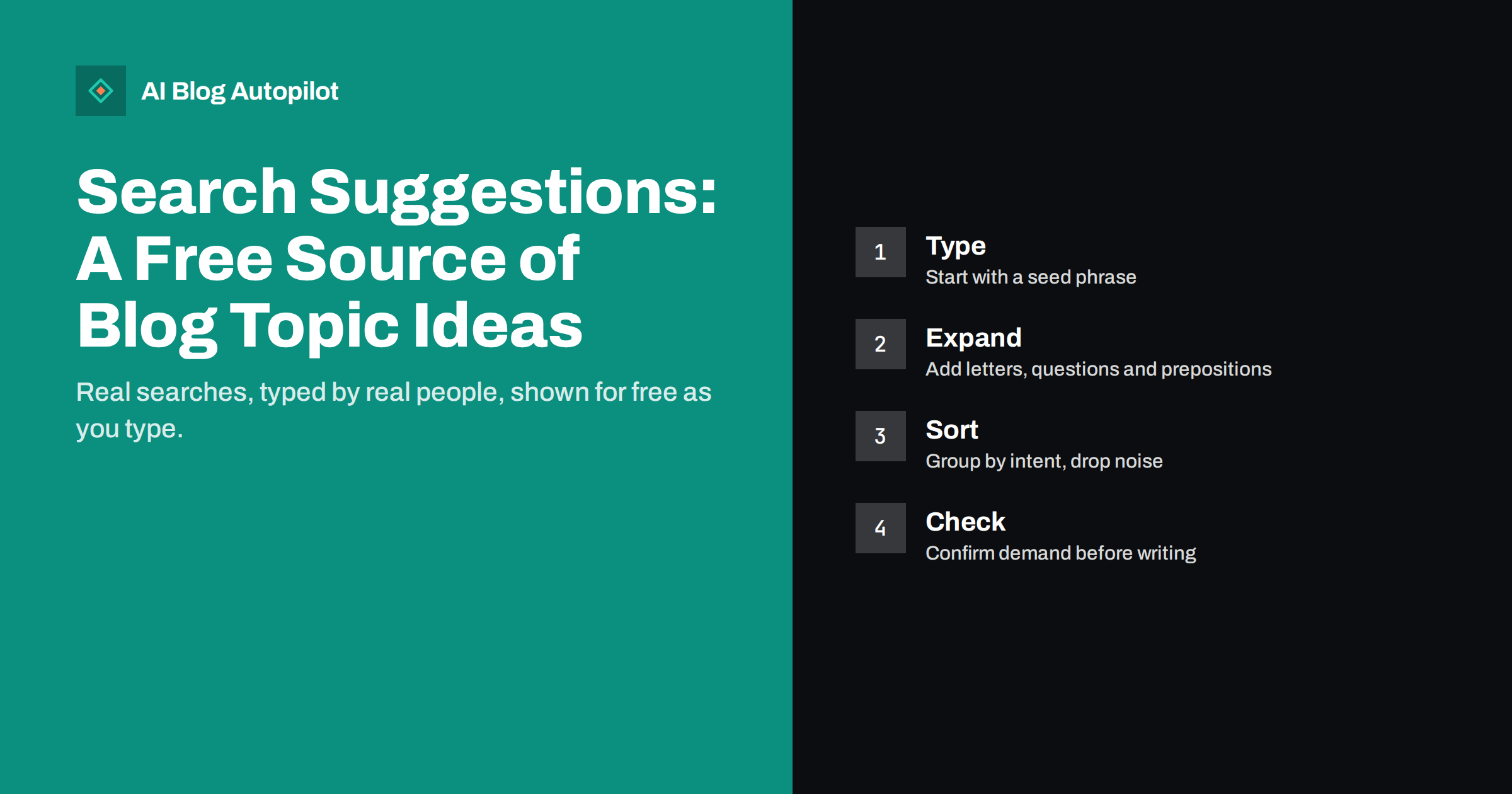
Short answer: search suggestions are the predictions a search engine shows while you type, and they are based on what many people actually search for. To use them for topic ideas, type a seed phrase, add letters, question words and prepositions, collect what appears, group the results by intent and check each promising idea against the real results page before you write.
Keyword tools can be expensive and, for a small blog, often more than is needed. The search box itself is a free source of ideas that reflect the language of real readers. The method is simple, but it only works well if you read the suggestions as clues about intent and not as a list of keywords to copy.
What search suggestions actually are
When you start typing a query, the search engine offers completions. They come from a mix of what people commonly search for, the language and location of the person typing, and sometimes recent interest. The exact method is not public, and the list can differ between people, places and days, so treat it as a sample and not as a fixed table of data.
A suggestion tells you that a phrase is natural, that somebody typed something close to it and that it is common enough to appear. It does not tell you how many people search for it, how hard it is to rank or whether a page on the topic would be useful to your readers. Those questions are answered in later steps.
Related searches at the bottom of a results page and the “People also ask” box are close relatives. They show how people reformulate a search after the first answer, which is a useful signal for the follow-up sections of a post. Our guide to using People Also Ask as a content source covers that box in detail.
Start with seed phrases from your business
A seed is a short phrase that names something you sell, explain or know. Use the words that customers use, not internal names. A bakery would try “sourdough”, “gluten free bread” and “wedding cake”, and a consultant might try “invoice”, “cash flow” and “bookkeeping”. Aim for ten to twenty seeds, and include one or two broad ones as well as several specific ones.
Use a private or logged-out window where you can, and set the location and language that match your readers. Personalised suggestions based on your own history will bend the list toward what you already read. If you serve several countries, repeat the exercise for each and note the differences, since the same topic may be phrased differently in different places.
Write the seeds in a spreadsheet and keep a column for the date. Suggestions change, and a note of when you looked is useful when you review the list a few months later.
Ask people as well. Staff who answer the phone, write replies or serve customers hear the exact words that people use, and those words make the best seeds. A short list of the ten questions heard most often this month, added to your seed sheet, will often give you better starting points than any tool.
Keep the first pass quick. Spend an hour on seeds and expansion, then stop and sort. A long, unsorted list is tiring to read, and the clusters become visible only after you group the phrases and remove the noise.
Expand each seed in a systematic way
Type the seed followed by a space and look at the list. Then add each letter of the alphabet in turn, so that “sourdough a”, “sourdough b” and so on reveal more completions. This is slow by hand but produces surprising ideas, particularly for long and specific phrases.
Add question words: how, why, what, when, can, should, is and does. Questions tend to show an informational need, which suits a blog. Add prepositions and comparison words as well: for, with, without, near, versus, or and like. A phrase such as “bookkeeping for freelancers” shows an audience, and “bookkeeping versus accounting” shows a comparison that people want explained.
Add the modifiers that readers use before they buy: best, cheap, easy, beginner, small business, checklist, template, example. These help you find the stage of the reader’s journey. Our guide to keyword modifiers for blogs explains what each family of modifiers usually signals.
Group the results by intent
Once you have a long list, sort it. Remove duplicates and near duplicates, and then group the phrases by what the reader wants. Four groups cover most cases: someone who wants to learn something, someone who wants to compare options, someone who wants to do something and someone who wants to buy or contact a business.
Each group suggests a format. Learning phrases suit explainers and guides, comparison phrases suit side-by-side posts and do-it phrases suit step-by-step instructions. Phrases with a clear commercial intent usually belong on a service or product page and not in a blog post. Read search intent explained if you want a more detailed way of sorting them.
Look for clusters. When five suggestions all circle the same worry, such as cost, time or risk, that worry deserves a post of its own, and the other phrases can become sections or FAQ entries inside it. This is how a list of loose phrases becomes a plan that links together, as described in our guide to content clusters and pillar pages.
Filter out what will not help
Not every suggestion is worth a post. Skip phrases that are about something you do not offer, that point to a brand you cannot compare fairly, that need professional advice you cannot give or that are too vague to answer in one page. Skip anything that is a spelling error unless you want to mention the correct term naturally in the text.
Be careful with news-driven suggestions. A phrase may appear because of an event this week and disappear next month. Use Google Trends to choose and time blog topics to see whether interest is lasting or only a spike.
Watch for topics where your readers’ health, money or legal position is at stake. These need careful sourcing and honest limits, and some may be better left to experts. A small blog gains little from a post it cannot support with real knowledge.
Check demand and competition before writing
Suggestions show that a phrase exists, so the next step is to see what the results page looks like. Search for the phrase and read the top results. Are they guides, product pages, forums or videos? Do they answer the question fully? Is there something that is missing, outdated or too general? A phrase where the first page is full of strong, specific answers may be too hard for now, while a phrase where the results are thin or off target is an opportunity.
Use your own data too. If your site is verified in a search console tool, look at the queries that already bring impressions, since they show where you are close to visibility. Our guide to finding article ideas in Search Console query data describes how to do it. A suggestion that matches a query where you already get impressions is a strong candidate.
If you can, compare with a low-cost keyword tool or the free methods in keyword research without paid tools. Volume estimates are rough, and a small number does not mean a phrase is unimportant, especially for a specific business with a narrow audience.
Mistakes to avoid
The first mistake is writing one thin post for every suggestion. Dozens of short pages that repeat each other compete among themselves and give readers little. Merge phrases that share an intent into one thorough post, and let the sections cover the variations. Our guide to keyword cannibalisation explains what happens when several pages chase the same query.
The second is ignoring the reader behind the phrase. A suggestion such as “how to cancel” signals a person with a problem and little patience, so the answer must be at the top. A suggestion such as “is it worth” signals someone weighing a decision who wants honest limits as well as benefits. Write for that person and not for the phrase.
The third is treating the list as permanent. Suggestions reflect habits at the time you looked, and habits change. If you plan a whole year from one afternoon of research, refresh the list before each quarter, and drop topics that no longer match how people search.
Turn the list into a calendar
Pick a manageable batch, perhaps ten ideas, and score each on three simple points: how well it fits your business, how much you can add that others have not, and how likely it is to bring the right readers. Write the winners in a calendar, mixing the easy and the ambitious.
For each chosen topic, write down the phrase, the intent, the format and two or three related phrases that should appear naturally in the text. Do not try to use every suggestion in the article. A reader wants a good answer, and a post that forces many near-identical phrases will read badly.
Repeat the exercise every quarter. New suggestions appear as products, tools and habits change, and old ones fade. Keep a “parked” list for ideas you decided against, with a note of why, so that you do not review the same phrase again and again.
How AI Blog Autopilot helps
AI Blog Autopilot plans the month from the topics you give it, with weights, keywords, audience and tone, and writes full SEO articles with FAQ sections, tags and SEO meta for your WordPress blog. Your suggestion research becomes the topic list: add the phrases you have chosen and the plan follows them. If you prefer to see each article first, you can switch on approval at any time. See the pricing page for plans.
Related reading
- Finding Article Ideas in Search Console Query Data
- Turning Customer Questions Into Useful Blog Topics
- Keyword Research Without Paid Tools: A Practical Method
The bottom line
Search suggestions are a free window into how people phrase their needs. Expand your seeds systematically, group the results by intent, filter out what you cannot answer well and check the real results page before you write.
FAQ
Are search suggestions the same as keyword volume?
No. They show that a phrase is commonly typed, not how many people search for it, so confirm demand with other data.
Why do suggestions differ between people?
They depend on location, language, recent trends and sometimes personal history, so use a logged-out window and note the country.
How many suggestions should I collect?
Enough to find clear clusters, usually a few hundred raw phrases that reduce to a dozen real topics.
Can I use every suggestion as a heading?
No. Use them to understand intent, and write natural headings that answer the question for a reader.
How often should I repeat the research?
Every quarter is enough for most small blogs, or sooner when you launch a new product or service.