ENEnglish
 LTLietuviškai
 DEDeutsch
 FRFrançais
 RUРусский
 ESEspañol
 PLPolski
 ITItaliano
 UKУкраїнська
 CSČeština
 PTPortuguês
 JA日本語
 LVLatviešu valoda
 ETEesti
 HUMagyar
 IDBahasa Indonesia
 TRTürkçe
 HIहिन्दी
 ELΕλληνικά
 ARالعربية
 THไทย
 VITiếng Việt
 RORomână
 MSBahasa Melayu
 BNবাংলা
Short answer: In AI Blog Autopilot you give each topic a weight, along with keywords, audience and tone, and the product plans the month from there. Give the highest weights to subjects that bring customers, a middle weight to supporting subjects and a small weight to side topics. Review the mix monthly, and change weights as results and seasons change.
A list of topics tells a writer what you care about. A list of weighted topics tells a planner how much. Without weights, a business with twenty subjects tends to get twenty equal shares, which dilutes the subjects that matter most and over-serves those that do not.
This guide explains how to think about topic weights in AI Blog Autopilot, with a worked approach for ranking, balancing and reviewing them. The product facts come from the home page. It does not give the exact arithmetic of how weights are applied, so treat the examples as a way of thinking, and check the details in your account.
What weights are and where the home page shows them
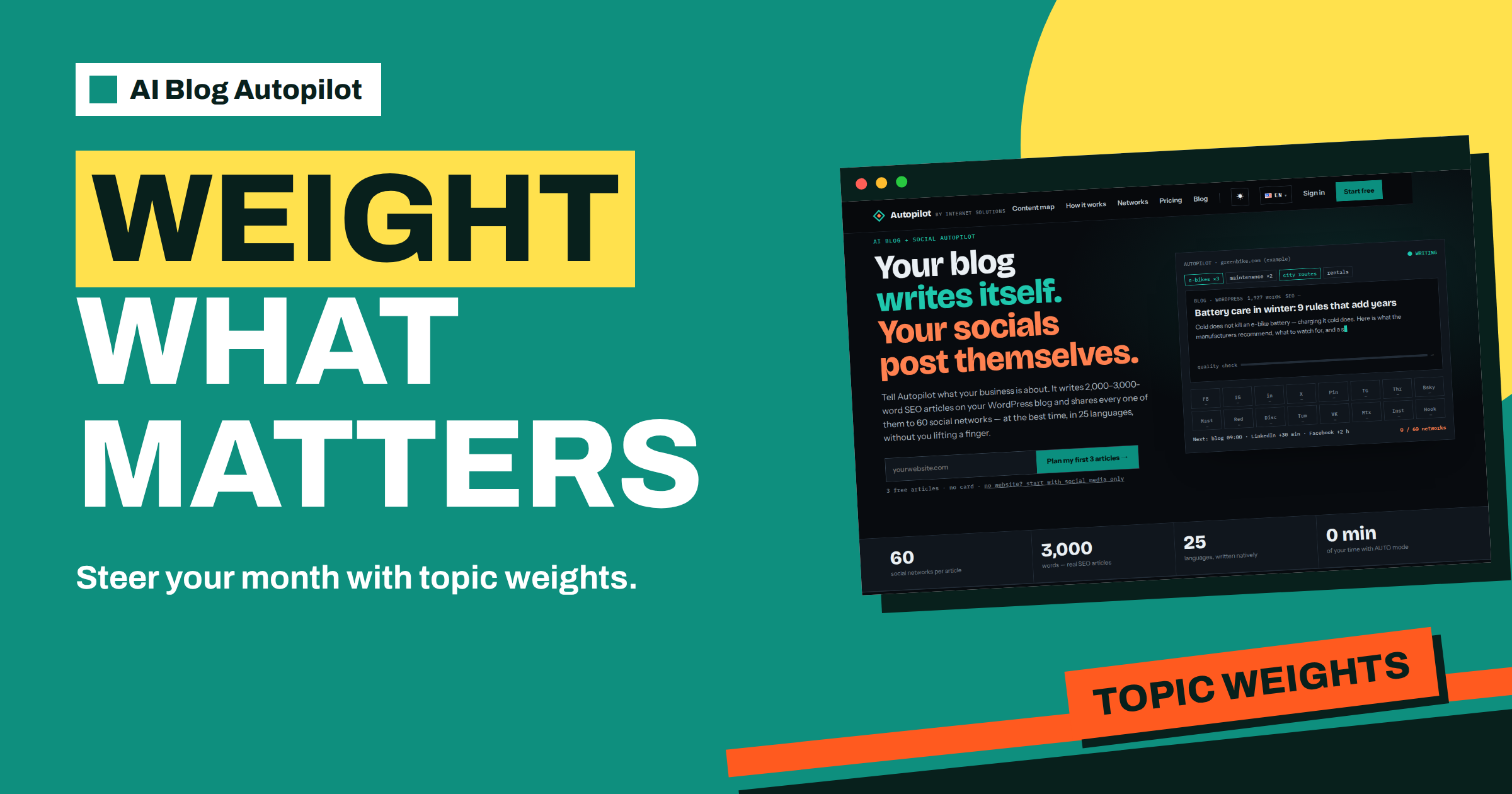
The home page says, under the step called Tell it the topics, that you give topics with weight, keywords, audience and tone, and that Autopilot plans the month from there. The demo shows the idea: chips for topics such as e-bikes, maintenance, city routes and rentals, with small multipliers next to some of them.
In the example, e-bikes carries a bigger multiplier than maintenance, and the others carry none shown. The suggestion is that a higher weight means a larger share of the month’s articles. The demo is an illustration for an example shop, not a rule for your account.
Think of the weight as an instruction about priorities. It says: this subject matters more to my business, so write about it more often. A well-chosen set of weights shapes the whole blog, which makes them one of the most useful settings in the product.
Rank your topics by business value
Start with a list of all the subjects you could write about. Then rank them by what they do for your business. Ask three questions of each: does it bring customers who buy, do customers ask about it often and can we speak about it with real authority?
Subjects that score high on all three are your main topics. A bike shop’s e-bikes are an example: they sell, customers ask about them and the shop knows them well. Subjects that score high on two are supporting topics, such as maintenance, which customers ask about and the shop knows, but which sells less directly. Subjects that score high on one are side topics, such as local routes, which bring readers but not directly customers.
Write the ranking down with a short reason for each. The reasons will help you review the weights later, and explain them to colleagues. The article on setting up topics in Autopilot describes how to gather and define topics before you weight them.
Turn the ranking into weights
Keep the scheme simple. Three levels are usually enough: high for main topics, medium for supporting topics and low for side topics. If the product offers numeric multipliers, use small numbers, such as three, two and one, so that the difference is clear without being extreme.
Avoid giving everything the same weight, because that tells the planner nothing. Equally, avoid giving one topic an extreme weight, since a month of articles on one subject can feel repetitive and thin. Variety helps readers and search engines see the breadth of your knowledge.
Check the result against your capacity. If you publish eight articles a month and have six main topics, each would get little more than one article. In that case, shorten the main list, or rotate topics month to month. The article on planning your monthly credits shows how to match topics to the number of articles you have.
Balance main and side topics
Main topics bring customers, but side topics bring readers, and readers become customers over time. A blog that only covers the product can feel like a brochure. A mix of main and side topics gives a fuller picture and attracts people at different stages.
A practical balance for a small business is that most articles come from main and supporting topics, with a smaller share from side topics. In an eight-article month, that might mean four main, three supporting and one side topic. This is an illustration, so adapt it to your goals.
Use side topics purposefully. Choose ones that your customers naturally care about, such as local events for a local business or industry news for a professional service. They should connect to your main topics, so that a reader can easily move from a side article to a product page.
Combine weights with keywords, audience and tone
Weights do not work alone. For each topic, the home page says to add keywords, audience and tone. Keywords tell the writer which phrases to aim for. Audience tells it who the reader is. Tone tells it how to speak. A heavily weighted topic with vague keywords will produce many articles that are not quite right.
Spend more effort on the details of the highest-weight topics, since they will appear most. Add at least five keywords the way customers phrase them, a clear audience description and an example of the tone you want. For lower-weight topics, shorter details are enough.
Also think about overlap. If two topics are very close, such as e-bike batteries and e-bike maintenance, the articles may cover similar ground. Define clearly what each covers, or merge them. The article on how to write a content brief for AI offers a template for each topic.
Review and adjust every month
Weights are not set for ever. Review them monthly, with the content map beside you. List which topics were covered, how many articles each received and how they performed. Look at visits, time on page, replies on social networks and enquiries that mention an article.
Move weight towards topics that work. If articles about a subject draw readers and enquiries, increase its weight. If a topic brings nothing after several articles, reduce it, or rewrite its keywords and audience. Give changes time to show, because a single article proves little.
Adjust for the calendar too. A garden centre will raise the weight of planting in spring, and a tax adviser will raise filing topics before the deadline. The home page says Autopilot plans the month from your topics, so update weights when your season changes.
Consider a short story. A small financial adviser starts with eight topics, all at the same weight, and gets a month of articles spread thin over everything from pensions to budgeting. She ranks the topics by value: retirement planning, which brings her best clients, gets the highest weight, savings habits and mortgages a medium weight and general money tips a low one. She adds keywords from client questions. Two months later, her retirement articles draw the most reading time, and several new clients mention them. She raises the weight a little more before the tax season, and lowers it afterwards.
The lesson is that weights are a steering wheel. Small, regular adjustments keep the blog pointed at what your business needs.
Common mistakes to avoid
The first mistake is too many topics. A list of twenty subjects with a month of eight articles means most topics never appear. Cut the list to what you can cover in a quarter, and rotate the rest. The second is equal weights, which tell the planner nothing about priorities.
The third mistake is weighting by what you enjoy writing about, instead of what the business needs. A fascinating side topic can take over the blog while the services that pay the bills get little attention. The fourth is never reviewing. A set of weights chosen in January may not suit June, so check them each month.
The fifth mistake is changing too much too fast. If you rewrite all the weights every week, you cannot tell what works. Change one or two things at a time, give them a month and then compare. Keep a short log of each change and the reason, so that you learn from your own decisions.
A worked example with an eight-article month
Take a small cleaning company with eight articles a month and five topics. Its main topic, regular home cleaning, gets the highest weight, its supporting topics, end-of-tenancy cleaning and office cleaning, get a medium weight, and its side topics, cleaning tips and eco-friendly products, get a low weight. In a typical month, the plan might give about three articles to regular home cleaning, one or two each to the supporting topics and one to the side topics.
Then the company looks at results after two months. Articles on end-of-tenancy cleaning bring the most calls, so the owner raises that weight, especially before the busy moving season. Eco-friendly products bring readers but no enquiries, so the weight stays low. In January, with fewer moves, the owner lowers end-of-tenancy and raises office cleaning, since businesses return to work and plan cleaning contracts.
The numbers in this example are illustrations, not rules. The point is the habit: set a plan from priorities, look at results, adjust and write down why. Over a year, this builds a clear view of what your blog is for.
It helps to keep a one-page record of your weights: the topics, the weights, the reason for each and the date you last changed them. Share it with anyone who reviews your articles, so they know what the blog is aiming for and can tell when an article is off target. When a colleague joins or an agency takes over, the page explains your priorities in a minute, and your blog keeps its direction even when the people around it change.
How AI Blog Autopilot helps
The product takes your weighted topics, keywords, audience and tone and plans the month, then writes, checks and publishes the articles and shares them to your networks. Try it with the three free articles on AI Blog Autopilot, no card needed, and see the plans on the pricing page.
Related reading
- Setting Up Topics in Autopilot
- How to Write a Content Brief for AI
- Planning Your Monthly Credits in AI Blog Autopilot
The bottom line
Rank topics by business value, use three simple weight levels, balance main and side subjects, support each topic with keywords, audience and tone and review the weights monthly against real results.
FAQ
What is a topic weight?
It tells Autopilot how much of the month a topic should get. The home page says you give topics with weight, keywords, audience and tone.
How many topics should I use?
Match them to your capacity. Five to eight topics suit most small businesses publishing around eight articles a month.
Should every topic have the same weight?
No. Equal weights give the planner no priorities, so rank topics by business value.
How often should I change weights?
Review monthly, and adjust sooner for seasonal changes or clear results.
Do weights replace keywords?
No. Weights set priority, and keywords, audience and tone shape each article.