ENEnglish
 LTLietuviškai
 DEDeutsch
 FRFrançais
 RUРусский
 ESEspañol
 PLPolski
 ITItaliano
 UKУкраїнська
 CSČeština
 PTPortuguês
 JA日本語
 LVLatviešu valoda
 ETEesti
 HUMagyar
 IDBahasa Indonesia
 TRTürkçe
 HIहिन्दी
 ELΕλληνικά
 ARالعربية
 THไทย
 VITiếng Việt
 RORomână
 MSBahasa Melayu
 BNবাংলা
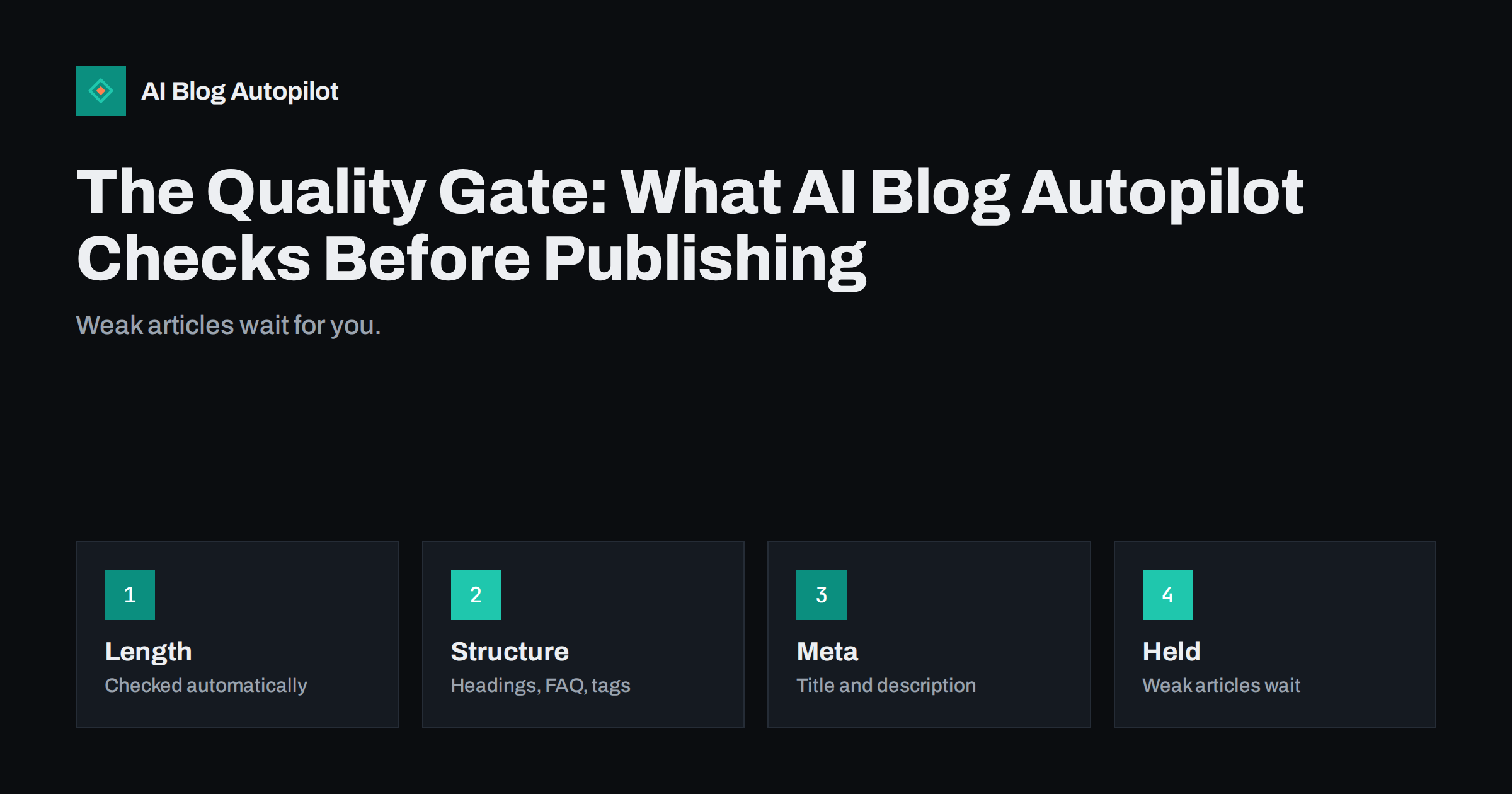
Short answer: the quality gate in AI Blog Autopilot is an automatic check that runs before an article goes live. According to the product, it checks length, structure, keyword and meta, and weak articles wait for you instead of being published. It reduces risk, but it does not replace your own knowledge of your business, so facts, prices and claims still deserve a look.
The biggest worry about automatic publishing is simple: what if something poor goes live while nobody is looking? A blog that publishes on its own needs a safety step between writing and publishing, otherwise speed turns into risk. The quality gate is that step.
This guide explains what the gate does in plain terms, how it fits with AUTO and approval modes, what to do when an article is held, and which checks remain your job. Everything about the product comes from its own pages, so check them for the current wording.
There is also a human reason. Owners who hand over their blog worry about losing control, and that worry is fair. A visible safety step answers it. You know that something checks each article, you know that a failed article waits, and you know where to look to confirm what happened. Control without daily effort is the whole point of a well-designed gate.
Why a gate matters in automatic publishing
When people write articles by hand, quality control happens naturally: the writer rereads, an editor reviews, someone presses publish. When articles are produced and published automatically, those moments disappear unless the system includes them. A gate puts a check back at the point where it counts, before anything reaches your readers.
The gate also protects the pace of publishing. A steady rhythm of useful articles builds a blog, while a burst of weak pages can damage trust. The product describes its approach as long-form articles planned around real search intent, checked automatically and published at a steady pace for each site, the opposite of mass-produced pages.
Think of the gate as a first line of defence, not the only one. It catches problems that can be measured by rule, such as a page that is too short or missing a part of its structure. It cannot know that your shop closed last month or that your price changed yesterday. That knowledge is yours.
Consider each check from the reader’s side. Length matters because a thin page rarely answers a question fully. Structure matters because readers skim, and headings and a FAQ section let them find the part they need. The keyword matters because it links the page to a real search. Meta matters because it is the first thing a searcher sees. Together they describe a page that is findable, readable and complete.
Notice what the list does not claim. It does not say that a passing article will rank, go viral or convert. Those results depend on competition, your site and your market. The gate raises the floor of quality; it does not promise a ceiling. Treat it as hygiene, like a spellcheck, and judge the articles by what they do for your readers.
What the gate checks
The product states that length, structure, keyword and meta are checked automatically. In practice that means four kinds of question. Is the article long enough to be a complete answer, given that articles can run up to 3,000 words? Does it have the expected structure, including headings, a FAQ section and tags? Does it use the planned keyword sensibly? Are the title and description in place for search results?
These are the points that decide whether a page can rank and be understood. A page with no clear structure is hard to read, a page without a title or description looks careless in search results and a page that never mentions its topic will not match what people search for. Checking them automatically on every article is tedious for a human but easy for a machine.
The home page also says that articles are planned around a real search query, with FAQ, tags and SEO meta. The gate is the final confirmation that these parts are present before publication. For background on why they matter, see the guide to meta titles and descriptions.
Keep a simple routine for held articles. Open the content map, find the held item and read it through once. Decide within a day whether to approve, edit or discard. A pile of held articles that nobody opens defeats the purpose of automation, because your calendar will have gaps and your readers will notice the silence.
If you edit a held article, keep the structure intact: the opening answer, the headings, the FAQ and the closing summary. Change facts and wording where needed, and check links. Small edits are usually enough, and the article then publishes as planned.
What happens to a weak article
The product says weak articles wait for you instead of going live. Rather than publishing something that fails the check, Autopilot holds it back so that you can look at it. That is the key promise: a failed check delays an article, it does not publish it by accident.
When an article is held, open it and see why. It may need a small edit, a change of topic wording or a decision to discard it. Use your judgement. If a held article looks fine to you, you can approve it. If it looks wrong, you can leave it unpublished or change the instructions that produced it.
Pay attention to patterns. If several articles on one topic are held, the topic settings may be too narrow or too vague. Adjust the keywords, audience or tone, and the next articles should pass more easily. The gate thus teaches you where your instructions need work.
বানানো তথ্য নেই
The product states that the writer is instructed never to make up statistics, quotes or sources. That is an important rule, because invented facts are one of the biggest risks in automated writing. A made-up number or a quote that nobody said can mislead readers and harm your reputation.
An instruction is not a guarantee, so treat it as a strong default, not a replacement for care. Read any article that makes a claim about numbers, laws, medicine, money or safety, and check that claim against a reliable source. The guide to fact-checking content before you publish lists the steps.
The best protection is to give the tool true material. Put accurate facts about your business in your topic descriptions: what you offer, where, for whom, and what you do not do. The more true detail the writer has, the less room there is for vague filler.
How the gate fits with AUTO and approval
AUTO is the default mode: no queue to approve, no daily log-ins. In AUTO, the quality gate is what stands between the writer and your readers, so it matters most. Articles that pass go live at your chosen hour and are shared to your networks, and those that fail wait.
Approval mode adds a human step. You see each article before it publishes and decide. This is useful for sensitive topics, for new blogs where you are still learning how the product writes and for businesses with strict rules on what may be said. The gate still runs, but you decide the final answer.
Many owners combine the two: approval for the first few weeks, then AUTO once they trust the results, with a weekly look at the content map to confirm what went out. The guide on draft, approve or full auto compares the options.
Build a short monthly review around three questions. Are the facts still true? Does the tone still sound like us? Are the topics still the ones our customers need? If the answer to any is no, change your topic settings that day. The tool follows your instructions, so the instructions are where your control sits.
Keep a note of any error you find and how it happened. If a wrong price appeared because the topic description was old, fix the description. If a tone problem came from an unclear brief, rewrite the brief. Over a few months the number of corrections falls, and you gain a clear record of what your blog stands for.
What you should still check
The gate cannot know your business as you do. Check the points that depend on current facts: prices, opening hours, offers, product names, staff names, locations and policies. If any of these have changed, update your topic descriptions, and review recent articles for out-of-date statements.
Check tone. A technically correct article can still sound wrong for your brand. Read two or three articles in full each month and compare them with how you would speak to a customer. Adjust the tone setting if they sound too formal, too casual or too salesy.
Check sensitive subjects. If your topics touch health, money, law or safety, a qualified person should review the articles, whatever tool wrote them. The guide to the pre-publication checklist gives a list you can adapt.
Reading the content map
The content map is how you see the gate’s results over time. A calendar shows when articles are planned and published, and a network matrix shows where each one was posted, with every cell linking to the live post. If something failed, it tells you exactly why.
Make the content map part of a weekly routine. Check that planned articles went out, look for held articles and note any failed posts or disconnected networks. Five minutes a week is enough to stay in control without doing the work yourself.
Over time, the map becomes a record of what you have published. Use it when planning topics, avoiding repetition and deciding what to update. It also helps in conversations with colleagues or clients about what the blog has done.
How AI Blog Autopilot helps
AI Blog Autopilot runs the quality gate on every article before it goes live and holds weak ones for you. See the pricing page for plans, and note the three free articles to test how the product writes for your business.
Related reading
- Quality Control When You Publish at Volume
- How to Edit an AI Draft: The Four Passes That Matter
- Is AI-Generated Content Bad for SEO?
The bottom line
The gate checks length, structure, keyword and meta and holds weak articles, while you stay responsible for facts, tone and sensitive topics.
FAQ
What does the quality gate check?
According to the product, length, structure, keyword and meta are checked automatically before an article goes live.
What happens when an article fails?
Weak articles wait for you instead of going live, so you can edit, approve or discard them.
Does the writer invent facts?
The writer is instructed never to make up statistics, quotes or sources, but you should still check important claims.
Do I still need to review articles?
Yes for facts that change, tone and sensitive topics. AUTO is the default and approval is optional.
How can I see what was published?
The content map shows a calendar and a network matrix with links to each live post and reasons for any failure.