ENEnglish
 LTLietuviškai
 DEDeutsch
 FRFrançais
 RUРусский
 ESEspañol
 PLPolski
 ITItaliano
 UKУкраїнська
 CSČeština
 PTPortuguês
 JA日本語
JA日本語 LVLatviešu valoda
 ETEesti
 HUMagyar
 IDBahasa Indonesia
 TRTürkçe
 HIहिन्दी
 ELΕλληνικά
 ARالعربية
 THไทย
THไทย VITiếng Việt
 RORomână
 MSBahasa Melayu
 BNবাংলা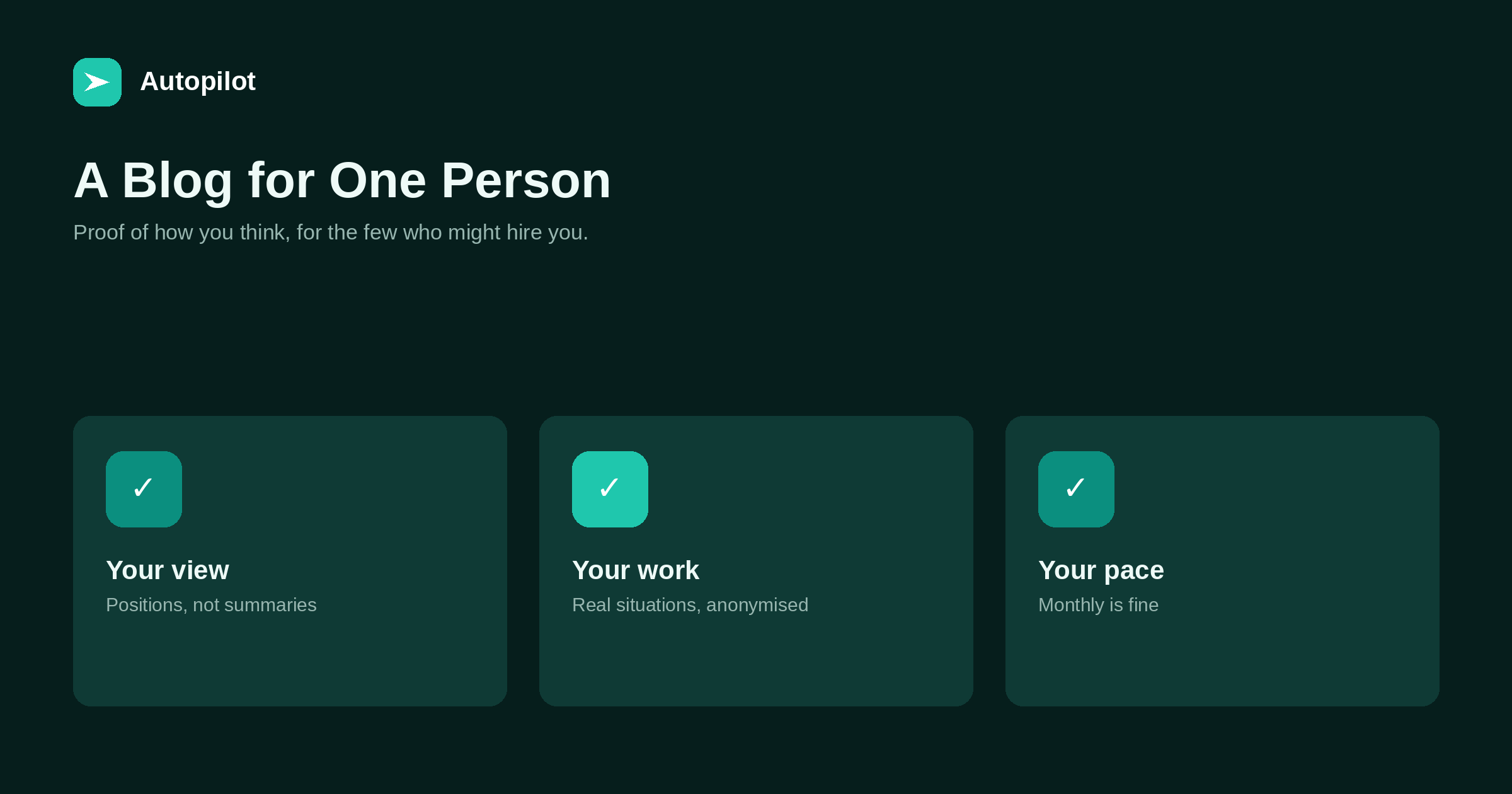
Short answer: for a consultant or freelancer, a blog’s main job is proof: showing prospective clients how you think and what you know, so that when they are deciding, you are already credible. That favours articles with a clear point of view, drawn from real (anonymised) client situations, on the specific problems your clients bring you. A steady pace of one or two strong articles a month is usually enough. Share them where your clients already are, often a professional network, and link them in proposals and conversations.
A one-person business rarely needs thousands of readers. It needs the right twenty people to trust its judgement before they pick up the phone.
That changes what a blog is for. It is less a traffic engine and more a portfolio of thinking: evidence that you understand the problems your clients have and have a view on how to solve them.
Proof over traffic
Most prospective clients of a consultant or freelancer check them out before deciding. They look at the website, read a few articles, perhaps look at a professional profile.
What they are assessing is whether you understand their situation and whether you think clearly. A handful of strong articles on exactly the problems they face answers that better than any service description, and it keeps working in every sales conversation you have.
What to write
The articles that do this job share some traits.
| Type | Why it works |
|---|---|
| A position on a common problem | Shows judgement, not just knowledge |
| An anonymised client situation | Shows experience, with specifics |
| How you approach a type of project | Lets clients picture working with you |
| A disagreement with standard advice | Distinguishes you from generic sources |
| Answers to questions clients always ask | Saves time in every sales call |
General explainers of your field are the least useful type: prospects can find them anywhere, and they reveal nothing about how you in particular think.
Your experience is the content
A consultant’s blog has a large advantage: every client engagement is material. The problem the client arrived with, what you expected, what was actually happening, what you did, what you learned.
Anonymise properly — sector and size rather than name, and change identifying details — or ask permission. Do not invent composite cases and present them as real. adding something original covers handling this material honestly.
Your name is the byline
For a one-person business, the author and the brand are the same. Every article should carry your name, a short bio saying what you do and for whom, and a link to your services page.
A real photograph helps here more than for a company blog, because clients are hiring a person. bylines and author pages covers what belongs in a bio.
How often
One or two strong articles a month is usually enough, and far more sustainable alongside client work than weekly posting.
Consistency matters more than volume: a blog whose last post is from two years ago suggests the business is quiet or gone. If time is tight, an automated draft on a question clients ask, heavily edited with your own view and examples, is a reasonable way to keep a steady pace. The additions are what matter; the draft only saves the blank page.
Where to share
Your clients’ attention is usually concentrated in a few places: a professional network, an industry newsletter, a community. Share there, in your own words, leading with the point of the article — LinkedIn for a business blog covers doing it well.
And use the articles directly. Link them in proposals, send them after a first call, point to them when a prospect asks a question they answer. This direct use is often where a consultant’s blog does most of its work.
Search, as a bonus
Search traffic is welcome but secondary for most consultants. Specific articles on narrow problems can rank and bring in the occasional perfect client, which is valuable precisely because they arrive with the exact problem you solve.
The long-tail approach in long-tail keywords suits consultants well: precise questions, low competition, readers who are close to needing help.
A simple structure for the site
A consultant’s site rarely needs much: a clear statement of who you help and with what, a services page, a page about you, a contact page, and the blog. The blog should link to the services page from every article, and the services page should link to the three or four articles that best show how you work.
Group articles by the problems clients bring rather than by date, so a visitor can quickly find everything you have written on their situation. A short list of recommended articles on the about page is often the most-read section of a consultant’s site.
Keep it current. An outdated services list or a contact form that no longer works undoes the credibility the articles build.
Staying consistent through busy months
Client work comes in waves, and blogs usually stop in the busy ones. Writing two or three articles during quiet periods and scheduling them ahead keeps the blog steady when you have no time, which is exactly when prospects are most likely to look you up.
Measuring it
Measure by conversations, not traffic. How many prospects mention an article? How many enquiries arrive after reading one? Which articles do you find yourself sending most often?
A blog read by a few hundred people a month can be very successful for a consultant if the right few contact them. No blog guarantees clients; a good one makes your expertise visible before the first conversation.
Related reading
If this was useful, these cover the questions that usually come next.
- Adding something original — the material only you have
- LinkedIn for a business blog — where a consultant’s articles travel
- Bylines and author pages — your name is the brand
The bottom line
Treat the blog as proof of how you think. Write positions, anonymised real situations and answers to the questions clients always ask, under your own name. Publish one or two strong articles a month, share them where your clients are, and use them directly in proposals and conversations. Measure by the conversations they start.
FAQ
Does a consultant need a blog?
It is one of the best ways to show prospective clients how you think before they contact you, and it gives you material to send during sales conversations.
What should a freelancer write about?
Positions on common client problems, anonymised real situations, how you approach projects, and answers to questions clients always ask. Avoid generic explainers.
How often should a consultant publish?
One or two strong articles a month is usually enough, and sustainable alongside client work. Consistency matters more than volume.
Can I write about client projects?
Yes, with permission or properly anonymised. Do not present invented or composite cases as real.
Should a consultant use automation for blogging?
It can help with a first draft, but the value of a consultant’s blog is their own view and experience, which must be added by hand.
How do I measure a consultant’s blog?
By the conversations it produces: prospects mentioning articles, enquiries after reading, and how often you send articles in sales discussions.