ENEnglish
 LTLietuviškai
 DEDeutsch
 FRFrançais
 RUРусский
 ESEspañol
 PLPolski
 ITItaliano
 UKУкраїнська
 CSČeština
 PTPortuguês
 JA日本語
 LVLatviešu valoda
 ETEesti
 HUMagyar
 IDBahasa Indonesia
 TRTürkçe
 HIहिन्दी
 ELΕλληνικά
 ARالعربية
 THไทย
 VITiếng Việt
 RORomână
 MSBahasa Melayu
 BNবাংলা
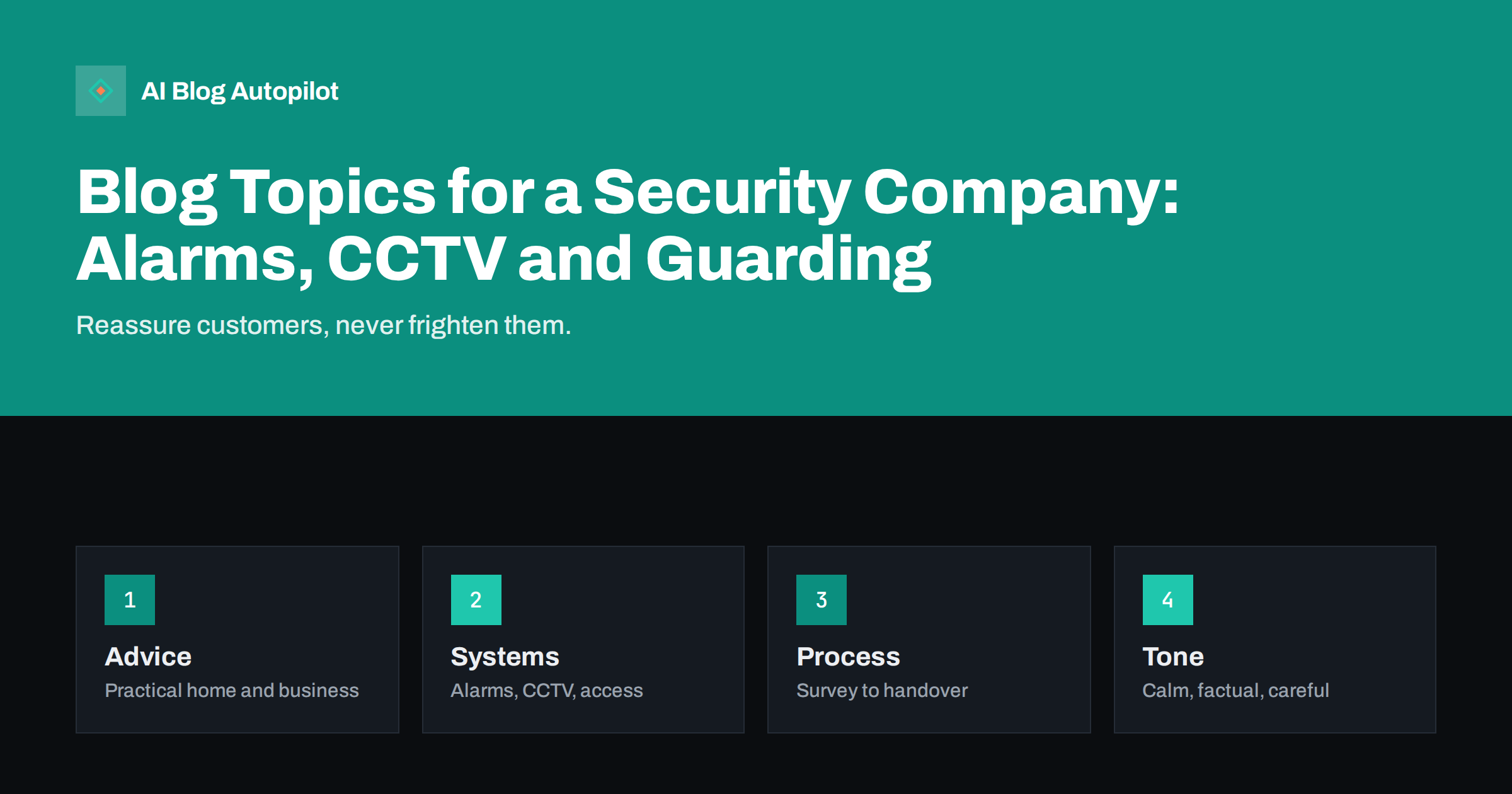
Short answer: a security company blog works best when it gives calm, practical advice on protecting homes and businesses, explains how systems and services work from survey to maintenance, and answers cost and privacy questions honestly. Avoid scare tactics, never give details that could help a burglar, and keep legal and data protection information careful.
People look for security services when they feel worried: after a break-in nearby, when opening a shop, when moving house or when responsible for a building. At that moment they want clear help, not fear. A blog that explains options calmly makes your company look competent and trustworthy before the first call.
This guide suggests topics for installers of alarms, CCTV and access control, and for guarding and monitoring companies. It also covers tone and risk, because security content has particular responsibilities that many other blogs do not.
Practical advice for homes
Homeowners search for simple steps they can take. Write guides on checking doors and windows, lighting, locks, keeping valuables out of sight, security when away on holiday and what to do after a break-in. Keep the advice proportionate, and avoid suggesting that crime is inevitable.
Explain how a home security system works in plain terms: sensors, a control panel, a siren, alerts to a phone or a monitoring centre. Describe what each part does and what it does not do. Readers appreciate honesty about limits, such as that a camera records but does not stop an intruder by itself.
Include guides for particular groups: renters who cannot make permanent changes, older people living alone, families with children and pets, and owners of second homes. Each has different needs and different worries, and a title that names the group speaks directly to them.
Write for sectors with special needs: schools, care homes, warehouses, farms, building sites, places of worship and vacant properties. Each faces different risks, and a guide titled for one of them is far more useful than a general one. Explain the typical weak points in general terms, such as unattended entrances or poor lighting, and the measures that suit the setting, without suggesting that any system makes a site safe from everything.
Describe how security fits with safety. Alarm and access systems must work with fire exits, evacuation and first aid, and a good installer thinks about both. A short article that explains this reassures managers who worry about doing the right thing and shows that your team understands the whole picture.
Advice for shops, offices and sites
Business owners ask different questions. Write about protecting a small shop, securing an office after hours, protecting stock and cash, keeping staff safe and preparing for insurance requirements. Explain the difference between prevention, detection and response, and how the pieces fit together.
Cover regular risks such as opening and closing routines, key control, visitors and contractors, and lone working. Practical checklists that a manager can adapt are very popular and are often shared by email. Link them from your service pages so that readers see the connection.
Mention that requirements vary by business, insurer and local rules. Encourage readers to ask their insurer what is needed, and offer a survey as a way to match the system to the site. The guide to blog strategy for a local business explains how to connect such articles to enquiries.
Write a jargon buster for the terms customers meet in quotes and manuals: zones, tamper, grades, resets, retention, motion detection and remote viewing. Keep each entry to two or three sentences. A glossary page is often searched and linked, and it saves time in every sales conversation because customers arrive already knowing the basics.
Add buying questions that customers can take to any supplier, including yours: what is included, who maintains the system, what happens in a power cut, how are false alarms handled and how long does a contract run. Giving readers a fair checklist shows confidence and builds trust, even when it helps them compare you with competitors.
Explain systems in plain language
Write product-neutral guides to the main technologies. Explain wired and wireless alarms, the idea of a monitored versus a local alarm, what motion sensors and door contacts do, and what false alarms are and how to reduce them. Describe the differences between recording methods and storage for CCTV, field of view, night vision and why placement matters.
Explain access control in simple terms: keys, fobs, cards, codes and phone-based entry, and the trade-offs in convenience, cost and control. Help readers think about who needs access, when and to where, and how to remove access when someone leaves.
Use diagrams where possible, with clear labels and good alt text. A simple plan of a house with sensors marked helps readers picture the system. Keep the details generic, as the guide to screenshots, diagrams and charts suggests, and never publish diagrams that show the layout of a real customer’s property.
Be careful about what you reveal
Security content has a special risk: information that helps the wrong person. Do not describe the weak points of specific products in ways that help bypass them, do not publish the details of real customers’ systems and do not show photographs that reveal the layout, codes or camera positions of a real site.
Avoid case studies that identify a customer’s address or exact premises. Use anonymised descriptions or obtain clear written permission and review images for anything sensitive. Even a logo on a shop front, a visible alarm panel or a view of a key safe can say too much.
Keep your own information safe as well. Do not publish the names of your engineers’ routes, the times of site visits or the details of the monitoring centre. A careless post can put colleagues and customers at risk.
Write too about cyber security where it touches physical systems. Network cameras and smart alarms connect to the internet, so explain in simple terms why strong passwords, updates and separate networks matter. Customers rarely think about this, and a short, clear guide shows that your company takes the whole risk seriously.
Privacy and legal questions
Customers often ask what the law says about cameras, recordings and monitoring. Write general, careful guides on who may be filmed, signs, how long recordings may be kept and what to do when someone asks for a copy of footage of themselves. Rules differ between countries, so describe the principles and link to the official guidance from your data protection authority.
Explain neighbours and cameras: pointing a camera at a public area or at a neighbour’s property can raise legal and personal issues. Offer sensible advice, such as aiming cameras at your own property and talking to neighbours. Say that readers should seek legal advice for particular situations.
Make sure your own pages follow the rules you describe. A company that explains data protection and then uses cookies carelessly looks hypocritical. The guide to privacy and analytics on a business blog is a good starting point.
Explain what to do when a system is not working, in a calm, step-by-step way: check the power, read the panel message, try a reset as described in the manual and call support if the fault remains. Make clear which actions are safe for customers to try and which should be left to an engineer. A helpful page like this reduces stress for the reader and calls to your helpline.
Describe the signs that an older system needs replacing, such as repeated false alarms, parts that are no longer made or cameras with poor image quality. Offer a fair view of upgrading versus replacing, without pushing a sale, and invite readers to book a review if they are unsure.
Cost, installation and maintenance
Cost is a major worry. Write an honest guide to what affects the price of a system: number of sensors, cameras, cabling, monitoring, installation time and ongoing support. Avoid quoting figures that will date. Explain the difference between buying, leasing and subscription models, and what is included in each.
Describe the process from enquiry to handover: a survey, a written quote, installation, testing, training and a handover pack. Explain what customers need to prepare, how long it takes and what happens if something goes wrong later. A clear picture of the steps reduces fear of the unknown.
Write about maintenance too: testing alarms, changing batteries, updating software, cleaning cameras and booking an annual check. These guides show customers that your relationship continues, and they help the page appear for searches long after installation.
Cover seasonal topics in a measured way: the darker months, holidays when buildings stand empty, festivals and events that need temporary security. Time these articles a few weeks before the season, and give practical steps instead of warnings. Readers act on clear advice and ignore fear.
Guarding, monitoring and response
If you offer manned guarding, patrols or remote monitoring, explain what each service does, who it suits and what customers can expect. Describe how an alarm is handled, from the signal to the check and the response, without giving details that could help someone avoid it. Explain licensing and training requirements, where they apply, in general terms with a link to the official source.
Introduce your people. Customers trust a company that shows its staff, explains their training and describes how they work. Use real photographs with permission, and avoid anything that identifies a client site.
Keep a calm tone about incidents. If you write about a real event, focus on lessons and avoid sensational details. The customer’s privacy and safety matter more than a dramatic story.
How AI Blog Autopilot helps
AI Blog Autopilot can write and publish articles on your chosen topics, with FAQ sections, tags and SEO meta, and share them to your social networks. Have a qualified person check legal and technical statements before each article goes live. See the pricing page for plans.
Related reading
- Blog Topics for Home Services Businesses
- Blog Topics for an IT Support Company
- Privacy and Analytics on a Business Blog
The bottom line
Give calm, practical advice, explain systems and costs honestly, protect customers’ details and keep every legal statement careful.
FAQ
What should a security company blog write about first?
Practical home and business safety checklists, plain explanations of alarms and cameras, and an honest guide to costs and the installation process.
How do I avoid scaring readers?
Stay factual and proportionate, offer steps they can take and avoid dramatic stories about crime.
Can I show photos of customer sites?
Only with written permission and after removing anything that reveals layouts, codes or camera positions.
Should I give legal advice about CCTV?
Describe general principles, link to the official data protection guidance and tell readers to seek advice for their own case.
Should I publish prices?
Prefer explaining what affects the price and offering a survey and written quote.