ENEnglish
 LTLietuviškai
 DEDeutsch
 FRFrançais
 RUРусский
 ESEspañol
 PLPolski
 ITItaliano
 UKУкраїнська
 CSČeština
 PTPortuguês
 JA日本語
JA日本語 LVLatviešu valoda
 ETEesti
 HUMagyar
 IDBahasa Indonesia
 TRTürkçe
 HIहिन्दी
 ELΕλληνικά
 ARالعربية
 THไทย
THไทย VITiếng Việt
 RORomână
 MSBahasa Melayu
 BNবাংলা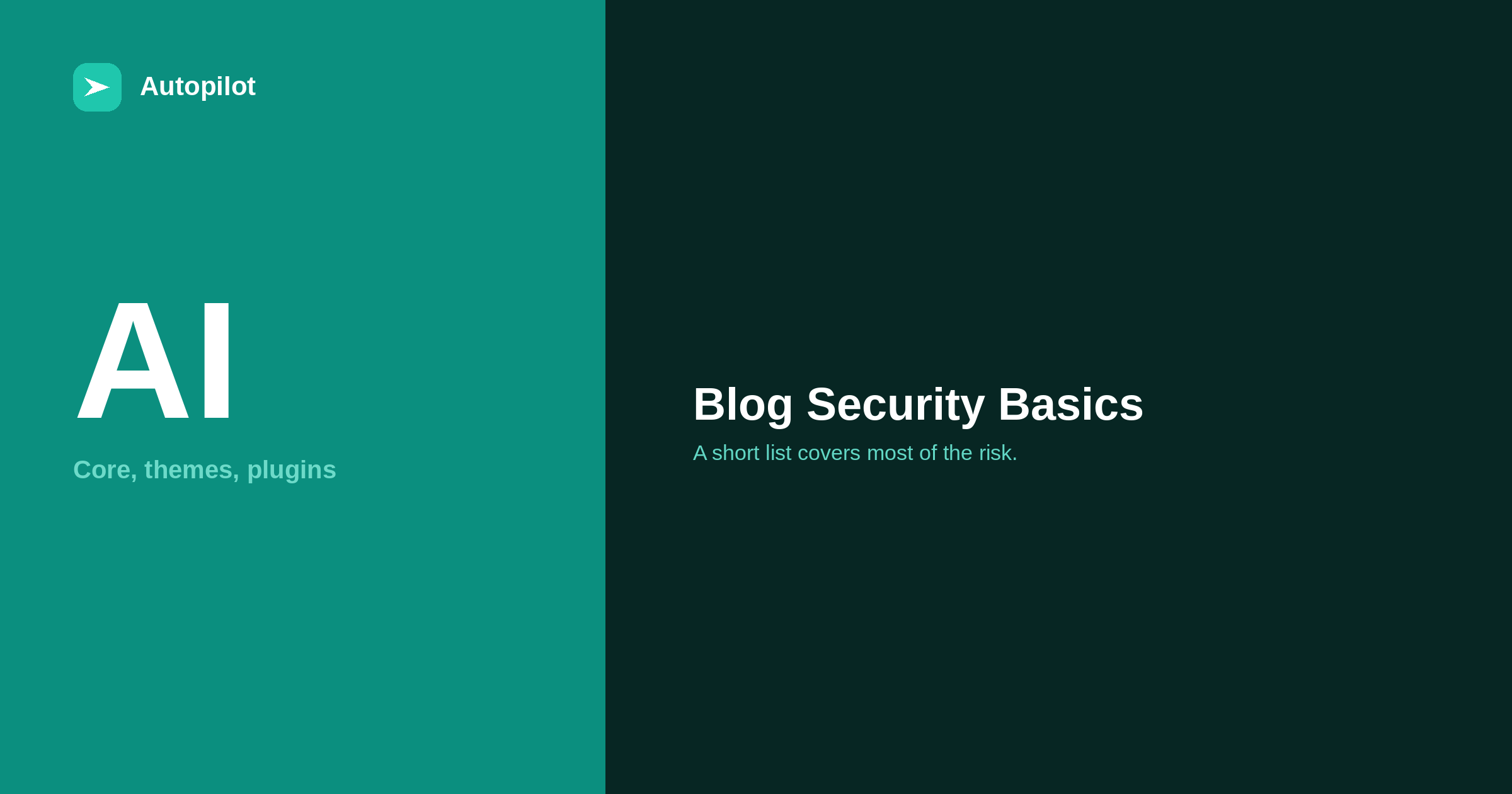
Short answer: most blog compromises come from outdated software, weak or reused passwords, too many administrator accounts, abandoned plugins, and tools given more access than they need. Keep core, themes and plugins updated; remove what you do not use; use strong unique passwords with two-factor authentication; keep administrators to a minimum; give publishing tools a limited account with an application password; run automatic backups stored off the site; and use HTTPS. Managed hosting can take on much of this for small businesses.
A compromised blog can serve spam or malware to readers, damage search visibility, and take days to clean up. Most compromises are not sophisticated; they exploit a handful of common weaknesses.
Covering those weaknesses is mostly routine maintenance. This is a practical overview for business blogs, not a full security guide.
Keep everything updated
Outdated software is the most common entry point. Keep the platform core, themes and plugins updated, ideally automatically for security releases.
Remove themes and plugins you do not use. Deactivated plugins can still be exploited if their files remain.
Choose plugins carefully
Every plugin adds code that must be maintained. Prefer plugins that are actively maintained, widely used and from reputable developers. Avoid plugins abandoned for years, and never install pirated premium plugins, which commonly contain malicious code.
Strong logins
Use strong, unique passwords for every account, stored in a password manager, and enable two-factor authentication for anyone with editor or administrator access.
| Practice | Why |
|---|---|
| Unique passwords | One leaked password does not open everything |
| Two-factor authentication | A stolen password alone is not enough |
| Few administrators | Fewer accounts that can change everything |
| Remove old accounts | Former staff and contractors |
| Lowest role needed | Writers do not need admin |
Review user accounts every few months.
Limited access for tools
Publishing tools and integrations should use their own account with the lowest role that works, authenticated with an application password that can be revoked without affecting anyone else — connecting WordPress safely.
Never give a tool your own administrator login. Revoke connections for tools you stop using.
Hosting and HTTPS
Reputable hosting with up-to-date server software, isolation between sites and security monitoring covers a large share of risk. Use HTTPS on every page.
Managed hosting for your platform often includes updates, backups and malware scanning, which can be worth the cost for small businesses without technical staff.
Backups
Automatic, regular backups stored separately from the site are the safety net for everything else. Test that they can be restored — backups and recovery.
Monitoring
Watch for signs of compromise: unfamiliar user accounts, unexpected pages or links, security warnings in Search Console, sudden traffic to strange URLs. Search Console notifies you of detected security issues, which is one more reason to have it set up — the Search Console reports that matter.
Security for multi-author blogs
Blogs with several writers, reviewers or agencies have more accounts and therefore more risk. Give each person their own account — never shared logins — with the lowest role their work needs: contributors who submit drafts, editors who publish, and very few administrators.
When someone leaves or a contract ends, remove their account the same day, along with any application passwords they created. A quarterly review of all accounts catches anything missed. Handing over a blog covers access changes in more detail.
Forms and spam
Contact forms, comment forms and sign-up forms attract automated abuse. Use spam protection, limit what forms accept, and keep form plugins updated. A form that sends email can be misused to send spam in your name if poorly configured.
Collect only the data you need through forms, and store it securely; form data is personal data and a common target — privacy and analytics covers handling it.
A quarterly security check
Once a quarter, spend twenty minutes on a short check: are core, themes and plugins updated; are there unused plugins or themes to remove; are all user accounts still needed, with appropriate roles; are application passwords for old tools revoked; are backups running and recent; does Search Console report any security issues? Recording the check each time builds a history that makes problems easier to spot.
Security and search
A compromised site can be flagged in search results with a warning, and injected spam pages can damage visibility long after the compromise is fixed. Quick detection and cleanup limit the damage. After cleaning, check for spam pages still indexed and request their removal, and request a review in Search Console if a security issue was reported.
Responsibility
Decide who is responsible for security: an in-house person, the host, or an outside provider. Unclear responsibility is how updates get skipped for months. Write it down alongside the other blog documents.
Admin area protection
Simple measures reduce automated attacks on the login page: limiting repeated failed login attempts, two-factor authentication, and not using obvious usernames such as admin. Some hosts also restrict access to the administration area by location or require an extra step before the login page appears.
None of these replaces updates and strong passwords, but together they remove most of the background noise of automated attempts.
Themes from reputable sources
Themes, like plugins, contain code that runs on your site. Use themes from reputable sources that are actively maintained, and keep them updated. A theme customised heavily by editing its files directly cannot be updated safely; use a child theme or the theme’s own customisation options instead, so security updates can still be applied.
Security for connected tools
Each connected tool is another route into the site. Keep a list of every tool with access: publishing, analytics, forms, backups. For each, note the account it uses and its role. When a tool is no longer used, revoke its access the same week. Managing several blogs covers keeping this under control across multiple sites.
Keeping it proportionate
Security for a business blog does not need to be elaborate. The routine above prevents most problems at modest cost in time.
If something goes wrong
If the site is compromised: change all passwords, revoke application passwords, restore from a clean backup or have the site cleaned, update everything, and check Search Console for security issues and request review once fixed. Consider professional help for anything beyond a simple case.
Related reading
If this was useful, these cover the questions that usually come next.
- Connecting WordPress safely — limiting tool access
- Backups and recovery — the safety net
- Choosing a blog platform — who maintains security
The bottom line
Keep software updated and remove what you do not use, choose maintained plugins, use strong unique passwords with two-factor authentication, keep administrators few, give tools limited revocable access, use reputable hosting and HTTPS, run tested off-site backups, and watch Search Console for security warnings.
FAQ
What are the most common causes of blog hacks?
Outdated software, weak or reused passwords, abandoned plugins, too many administrators and tools with excessive access.
Should publishing tools have admin access?
No. Use a limited account and an application password that can be revoked.
Are unused plugins a risk?
Yes, even when deactivated. Remove plugins and themes you do not use.
Is two-factor authentication necessary?
For anyone with editor or administrator access, it is strongly recommended.
Does managed hosting help with security?
Often, through updates, backups and malware scanning handled for you.
What should I do if my blog is hacked?
Change passwords, revoke application passwords, restore a clean backup or clean the site, update everything, and check Search Console.