ENEnglish
 LTLietuviškai
 DEDeutsch
 FRFrançais
 RUРусский
 ESEspañol
 PLPolski
 ITItaliano
 UKУкраїнська
 CSČeština
 PTPortuguês
 JA日本語
JA日本語 LVLatviešu valoda
 ETEesti
 HUMagyar
 IDBahasa Indonesia
 TRTürkçe
 HIहिन्दी
 ELΕλληνικά
 ARالعربية
 THไทย
THไทย VITiếng Việt
 RORomână
 MSBahasa Melayu
 BNবাংলা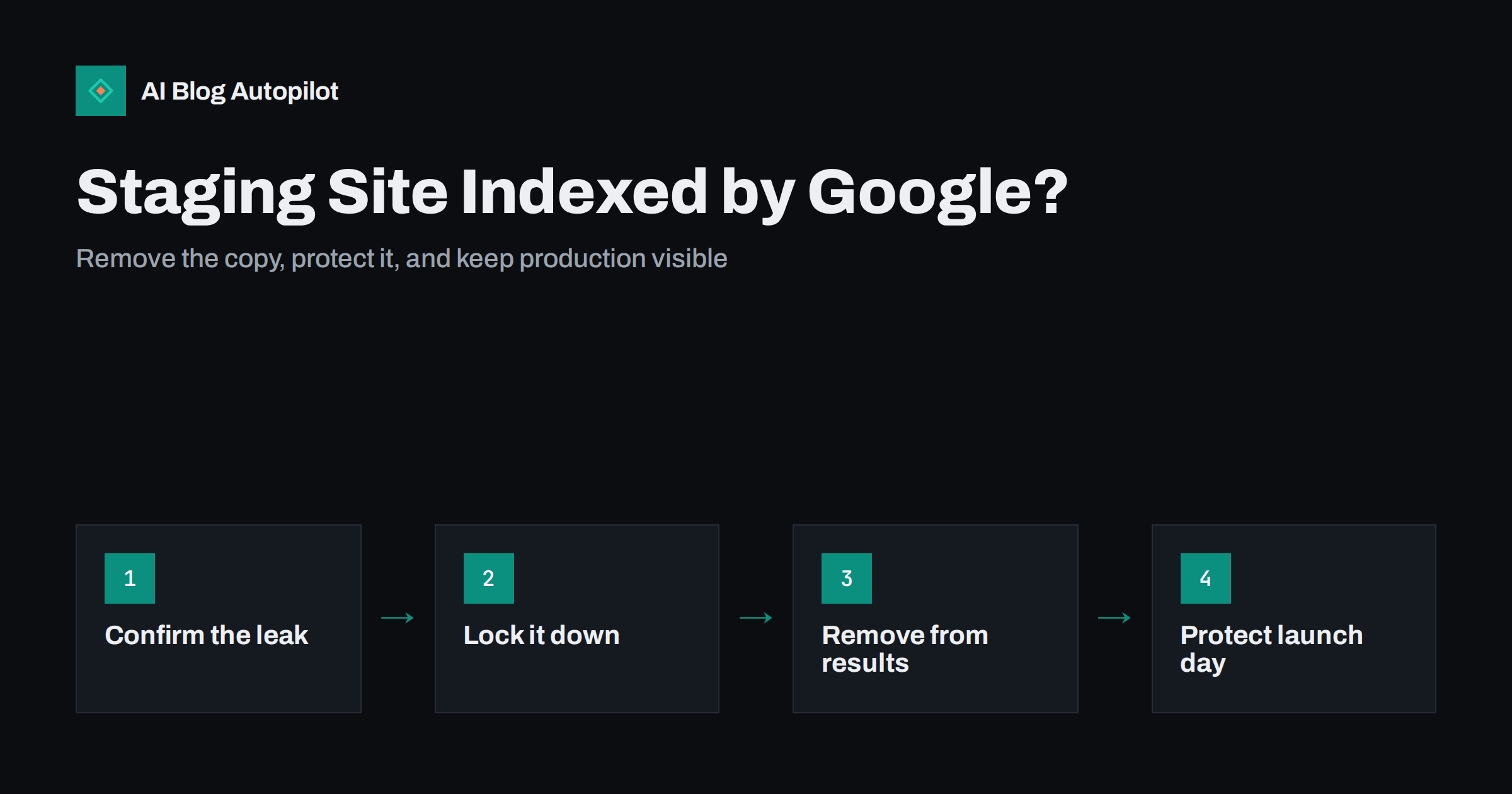
Short answer: if a staging or test copy of your blog appears in search results, protect it with a password (HTTP authentication) or a noindex directive, then use the Removals tool in a Search Console property for the staging hostname to hide it quickly while it drops out of the index. Do not rely on robots.txt alone: it blocks crawling, which also stops search engines from seeing the noindex, and blocked URLs can still stay indexed. Finally, check that your live site was not accidentally set to noindex in the process.
Staging sites are meant to be private workshops: a copy of the blog where you test a new theme, a plugin update or a redesign before it goes live. They are often created in a hurry, on a subdomain like staging.example.com or a temporary host address, and nobody remembers to hide them. Search engines find them through a stray link, a sitemap, a shared URL or simply because the hostname is discoverable, and suddenly an unfinished copy of your content is sitting in the results.
This guide explains why that matters, how to clean it up without harming the live site, and how to set up future staging environments so it does not happen again.
Why an indexed staging site is a problem
An indexed staging copy is rarely a disaster, but it causes real, avoidable issues:
- Duplicate content. The same articles exist at two addresses. Search engines usually work out which one is the original, but not always, and the wrong version can occasionally be shown.
- Confused visitors. People who land on the staging copy see outdated or broken pages, test posts, placeholder text or a half-finished design.
- Security exposure. Staging sites are often less carefully maintained than production, with outdated plugins or debug settings. Having them in search results makes them easier to find.
- Messy data. Leads or comments submitted on a staging copy may go nowhere, and analytics can be polluted if the tracking code is copied across.
The good news is that the fix is straightforward, and the live site is usually unaffected once the copy is removed.
Step 1: confirm what is indexed
Start by finding out how much of the staging site is visible.
- Search for
site:staging.example.com(with your staging hostname) to get a rough sample of indexed pages. The count shown is an estimate, not an exact figure. - Search for a distinctive sentence from one of your posts in quotes and see which addresses appear.
- Check whether the staging site has its own sitemap or links pointing to it from the live site, social profiles or documentation. Those are the usual discovery routes.
Also note the exact hostnames and protocols involved. Sometimes there are several: a staging subdomain, a development subdomain and a temporary address from the hosting company.
It also helps to know why staging copies get found in the first place, because that tells you which leak to plug. The most common routes are a link from the live site left behind after testing, a staging sitemap submitted by an SEO plugin that was active on the copy, absolute URLs in emails or newsletters sent from staging, a URL pasted into a public chat or support forum, and certificate transparency logs that list every hostname for which a TLS certificate was issued. The last one surprises many people: simply creating a secure subdomain makes its name publicly discoverable. That is another reason to rely on authentication rather than on nobody knowing the address.
Step 2: choose how to block it
There are three common ways to keep a site out of search results. They do different things, and the difference matters.
| Method | What it does | Removes indexed pages? | Best use |
|---|---|---|---|
| Password protection (HTTP authentication) | Crawlers and visitors cannot see any content without credentials | Yes, over time, as pages return an authentication error | The preferred default for staging |
| Noindex (meta robots tag or X-Robots-Tag header) | Pages can be crawled but are kept out of the index | Yes, once each page is recrawled | When the site must stay publicly reachable |
| robots.txt disallow | Asks crawlers not to fetch pages | No, and it hides the noindex from crawlers | Not a way to remove pages from the index |
Password protection is the most robust choice for a staging environment: nobody who should not see it can see it, including crawlers, and there is no directive that can be accidentally copied to production. Google’s documentation on blocking indexing with noindex explains the noindex route and why robots.txt must not block the pages you want dropped.
Step 3: remove it from results quickly
Blocking the site stops the problem growing, but already-indexed pages disappear only as search engines revisit them. To speed things up:
- Verify the staging hostname in Search Console. Add it as its own property. You need to own a property to request removals for it. Verification via DNS works even if the site is password-protected.
- Use the Removals tool. Submit a temporary removal for the whole staging hostname using the prefix option. This hides the URLs from Google results for about six months.
- Keep the block in place. The temporary removal is only a curtain. The pages drop out permanently because of the password protection or noindex you added in step 2. If you remove the block before they have dropped out, they can come back.
Bing Webmaster Tools has its own content removal options if the staging site also appears in Bing.
What about redirecting or canonicalising the staging site?
Two other ideas come up often.
- Redirecting staging to production. If the staging site is no longer needed, a permanent redirect from each staging URL to its live equivalent is a clean solution: search engines consolidate the signals onto the live pages. It is not suitable if you still need to use the staging environment.
- Canonical tags pointing to production. A canonical tag is a hint, not a command. It can help consolidate duplicates, but it does not reliably keep a staging copy out of results, and it is easy to get wrong when content differs between the two versions. Use it as a supplement at most.
For an environment you will keep using, password protection plus a temporary removal is simpler and more predictable.
The most dangerous mistake: noindex on the live site
The reverse problem is more harmful. When a site is copied from staging to production, the “hide from search engines” setting sometimes travels with it. On WordPress, the setting “Discourage search engines from indexing this site” under Settings, Reading adds a noindex directive to every page. Launching with that setting on can remove a whole blog from search results over the following weeks.
After every launch, migration or big deployment, check the live site:
- View the source of the home page and a post, and search for
noindex. - Check the response headers for an
X-Robots-Tagheader. - Open the live robots.txt and confirm it does not contain
Disallow: /for all crawlers. - Run a URL inspection on a key page in Search Console and confirm indexing is allowed.
This is exactly why password protection is preferable for staging: an authentication rule usually lives in the server configuration of the staging host and is not copied along with the database or files.
Preventing it next time
A few habits keep staging sites private:
- Password-protect staging from the first minute, before any content is copied across.
- Use an obscure hostname if you can, and never link to it from the live site, public documents or social media.
- Do not submit staging sitemaps and disable sitemap generation on staging if your SEO plugin allows it.
- Disable tracking and outgoing emails on staging so copied analytics tags and notification emails do not leak.
- Write a launch checklist that includes switching indexing on for production and confirming it with a real check, not an assumption.
- Delete old staging copies you no longer use. An abandoned environment is the one most likely to be forgotten and left open.
If an agency or developer builds sites for you, ask them how staging is protected. It is a reasonable question, and a good answer is a sign of a careful workflow.
Checking that the cleanup worked
Give it a few weeks, then confirm:
- A
site:search for the staging hostname returns nothing or almost nothing. - Search Console for the live property shows stable or growing indexed pages, with no new “Excluded by noindex” entries for live URLs.
- Searching a distinctive sentence from your posts shows only the live address.
If staging pages reappear after the temporary removal expires, the block from step 2 was not in place or not working. Test it by requesting a staging URL without credentials: it should return an authentication prompt or a page with noindex.
How AI Blog Autopilot fits
AI Blog Autopilot publishes articles to your live WordPress blog through a one-click connection, or to other platforms through a webhook or API. It writes and publishes; it does not change your indexing settings, robots.txt or server configuration, so the checks above stay in your hands. If you run a staging copy, connect Autopilot only to the production site so new articles appear in one place. Read more about how Autopilot connects to your blog.
Related reading
- Duplicate Content: What Counts and What Doesn’t
- Canonical Tags Explained Without the Jargon
- Migrating a Blog Without Losing Its Traffic
- Security Basics for a Business Blog
The bottom line
An indexed staging site is a fixable nuisance. Protect it with a password or noindex, verify the staging hostname in Search Console and request a temporary removal, and keep the block in place until the pages drop out. Do not use robots.txt as a removal tool. Above all, check after every launch that the noindex meant for staging did not end up on your live blog.
FAQ
How do I remove a staging site from Google quickly?
Verify the staging hostname as a Search Console property and submit a temporary removal for the whole prefix. That hides it for about six months. At the same time, add password protection or noindex so the pages drop out permanently before the temporary removal expires.
Is robots.txt enough to keep a staging site out of search?
No. A robots.txt disallow stops crawling but does not remove pages that are already indexed, and it prevents search engines from seeing a noindex tag. Blocked URLs can still appear in results, usually without a description.
Will an indexed staging site hurt my live site’s rankings?
Usually not severely, because search engines tend to recognise the original. It can still cause the wrong version to show up occasionally, confuse visitors and expose an outdated copy of your site, so it is worth cleaning up.
What is the safest way to protect a staging site?
HTTP authentication, meaning a username and password required by the server before any page loads. It blocks both people and crawlers and is not copied to production along with the site’s files and database.
How do I know if my live site was accidentally set to noindex?
View the page source and response headers of a few live pages and look for noindex, check robots.txt, and use URL inspection in Search Console. On WordPress, also check that the “Discourage search engines” option under Settings, Reading is switched off.