ENEnglish
 LTLietuviškai
 DEDeutsch
 FRFrançais
 RUРусский
 ESEspañol
 PLPolski
 ITItaliano
 UKУкраїнська
 CSČeština
 PTPortuguês
 JA日本語
 LVLatviešu valoda
 ETEesti
 HUMagyar
 IDBahasa Indonesia
 TRTürkçe
 HIहिन्दी
 ELΕλληνικά
 ARالعربية
 THไทย
 VITiếng Việt
 RORomână
 MSBahasa Melayu
 BNবাংলা
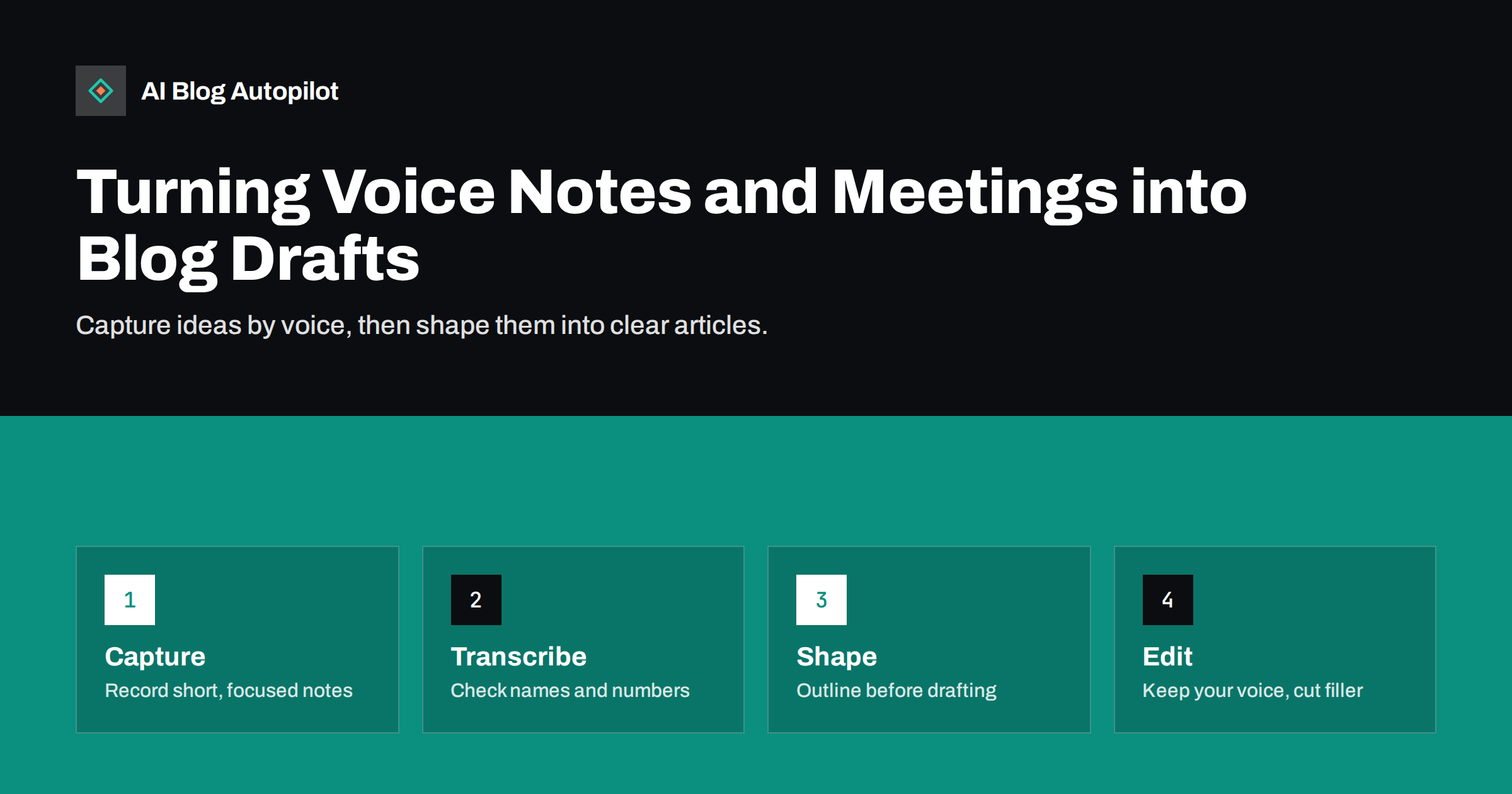
Short answer: speaking is often the fastest way to capture expertise, and a voice note, a call or a meeting can become a solid blog draft if you follow a simple order: record with a topic in mind, transcribe, check names and figures, turn the transcript into an outline, draft from the outline and edit for clarity while keeping your own phrasing. Never publish a raw transcript, ask permission before using other people’s words, and keep private or confidential details out of public articles.
Many business owners and specialists know far more than they ever write down. They explain a topic fluently to a customer on the phone and then struggle for an hour with a blank page. Speaking removes that barrier. The challenge is the step after the recording, because spoken language is full of repetition, tangents and half-finished sentences. This article shows a practical workflow for moving from speech to a good article.
Why spoken material works well
People speak in examples, stories and direct answers. When you explain something to a colleague, you naturally pick the clearest illustration and skip what the listener already knows. Those are exactly the qualities that make an article useful. Spoken material also carries your real vocabulary and rhythm, which helps the finished piece sound like a person and not like a template.
It has practical advantages too. You can capture ideas while walking, driving as a passenger or between tasks, and you can record a conversation that you were having anyway. The cost is a transcript to clean up. For most experts, that is far less effort than writing from nothing, and the result contains real experience that a generic draft would lack.
Step one: record with a purpose
A rambling recording is difficult to use. A little preparation gives you material that is easy to shape.
- Choose one question. Start from a single question a customer might ask, such as “How do I choose a size?” or “What should I check before signing?”
- Jot three or four points that you want to cover, in the order you would explain them.
- State the topic aloud at the start, along with the date, so that the file is easy to find later.
- Speak in short sections. Pause between points. Two to five minutes per topic is plenty.
- Add an example. Describe a real situation, with details you can later anonymise.
- End with a summary. Finish with the main advice in two sentences, since that often becomes the opening of the article.
Record in a quiet place when possible, and keep the microphone close. Poor audio is the main reason transcripts contain errors, and errors cost editing time. If you record on a phone, test the first ten seconds by playing it back, and avoid recording while the device is in a bag or near a noisy fan.
Recording meetings and calls: permission first
Recording conversations with other people raises legal and ethical questions that you must settle before you press the button. Laws on recording differ between countries and regions, and some require the consent of everyone on the call. Always tell participants that you are recording, say why, and ask for agreement. If the conversation includes customers or colleagues, also ask whether you may use their words, their names or any details in a public article. When in doubt, ask for it in writing or in an email follow-up, and let people see how they will be quoted.
- Do not use material from private or confidential meetings unless everyone involved agrees.
- Remove names, company details and figures that could identify a customer unless you have permission.
- Be careful with personal data, health, legal and financial details, which carry extra obligations.
- Keep recordings and transcripts in a secure place, and delete them when they are no longer needed.
- If a transcription service processes the audio, check where the data goes and how it is used, and make sure that this is compatible with what you promised the participants.
This is general guidance and not legal advice. If your work involves sensitive information, such as clients’ private matters, take advice on what you may record and publish.
Step two: transcribe and verify
Transcription tools are fast and often accurate, but they make mistakes, especially with names, product terms, accents, numbers and technical vocabulary. Treat the transcript as a rough draft of the facts, not as a reliable record. Read it while listening to the recording at the key points.
- Check every name, company, place and product against a reliable source.
- Check numbers, dates, units and prices, which are the most dangerous errors.
- Mark places where the speech was unclear, and either re-record them or remove them.
- Correct industry terms, which tools often turn into similar-sounding common words.
- Remove filler, repeated starts and side comments that do not help the reader.
Keep the original recording until the article has been published and checked. If a reader or customer questions a statement, you will want to be able to go back to what was actually said.
Step three: find the structure
A transcript is in the order you spoke, which is not always the order a reader needs. Read it once from top to bottom and highlight the main ideas. Then write an outline that answers the reader’s question as directly as possible.
- Write the question the article will answer and a two-sentence answer for the opening.
- List the main points in a logical order, such as steps, from most common to least, or from simplest to hardest.
- Assign the examples and stories from the recording to the point that they illustrate.
- Note what is missing, such as a definition, a warning or a source that the reader will need.
- Decide which parts of the recording will not be used, and set them aside for another article.
Often one recording supplies two or three articles. A twenty-minute meeting may contain a how-to, a list of common mistakes and a story. Splitting them gives each piece a clearer focus. It also makes your publishing plan easier, since a single hour of speaking can feed the calendar for a month.
Step four: draft and keep your voice
Write the first draft from the outline, borrowing phrases from the transcript where they are clear. The aim is not to copy the spoken text, but to keep what made it good: the plain words, the concrete example, the direct advice. Written sentences usually need to be shorter and more structured than spoken ones.
- Turn long spoken sentences into two or three short ones.
- Replace “you know” style fillers and vague references like “that thing” with exact words.
- Keep signature phrases and humour that suit your brand, but avoid in-jokes that readers will not understand.
- Add headings, lists and short paragraphs so that readers can scan.
- Define terms that you used without noticing, since experts rarely explain their own vocabulary.
If you use an AI tool to help with the draft, give it the verified transcript and your outline, ask it to stay within the facts that are there and review the result carefully. Our guides on brand voice guidelines and on editing AI drafts explain how to keep control of tone and accuracy.
Step five: edit, check and publish
Finish with the same editorial checks as for any article. Read the piece aloud, because it is the best way to find sentences that do not flow. Verify all facts and figures a second time, ask the people quoted to approve their quotations and add a clear introduction and conclusion. Check that the title and headings match what people search for, and add a short FAQ for the questions you answered in the recording.
Do not leave the article as a transcript with light editing. Raw transcripts are hard to read, repetitive and thin on structure, and they rarely meet the standard that readers and search engines expect. A published article should be organised for the reader, not for the speaker. Ask a colleague who did not attend the conversation to read the draft. If they can follow it and explain the main advice back to you, the structure works.
Build a habit that lasts
The workflow is most valuable when it becomes routine. Keep a note on your phone for topic ideas, record one short note per week and set aside a regular hour to turn the best one into an article. Keep a shared folder with the recording, the transcript, the outline and the final text, so that you can find and reuse material later.
Review the results every few months. Which topics gave the best articles? Which recordings needed the most editing? Adjust your preparation accordingly. Over time, you will build a bank of material that reflects your real expertise, and that is hard for anyone else to copy. Label each file with the topic and date, and note which ones have already been used, so that nothing is published twice by accident.
How AI Blog Autopilot helps
AI Blog Autopilot takes the routine work off your hands: you give it topics with weight, keywords, audience and tone, and it plans and writes the articles, with AUTO as the default and approval available if you prefer to see each one first. Your voice notes remain the best source of your own stories and examples. See the pricing page for plans.
Related reading
- Interviewing Experts for Your Articles
- How to Edit an AI Draft: The Four Passes That Matter
- How to Write Brand Voice Guidelines an AI Can Follow
- Running a Business Blog in Two Hours a Week
The bottom line
Speech is a fast way to capture what you know. Record short, focused notes, get permission before using other people’s words, check every name and number in the transcript, build an outline before drafting and edit until the piece is organised for the reader. Keep your own phrasing and examples, protect confidential details and turn the habit into a weekly routine.
FAQ
Can I publish a transcript as an article?
Not as it is. Raw speech is repetitive and poorly structured. Use the transcript as source material, then outline, draft and edit it for readers.
Do I need permission to record a meeting?
Often yes. Rules differ by country, so tell participants, explain the purpose and get their agreement. Ask again before quoting them publicly.
How accurate are transcription tools?
They are good but not perfect, particularly with names, numbers and technical terms. Always check these against the audio and reliable sources.
How long should a voice note be?
Two to five minutes on a single question works well. Short, focused notes are easier to transcribe and shape than long recordings.
Can an AI tool turn a transcript into a draft?
It can help, if you provide the verified transcript and an outline and review the result for accuracy, tone and any claims not in the source.