ENEnglish
 LTLietuviškai
 DEDeutsch
 FRFrançais
 RUРусский
 ESEspañol
 PLPolski
 ITItaliano
 UKУкраїнська
 CSČeština
 PTPortuguês
 JA日本語
JA日本語 LVLatviešu valoda
 ETEesti
 HUMagyar
 IDBahasa Indonesia
 TRTürkçe
 HIहिन्दी
 ELΕλληνικά
 ARالعربية
 THไทย
THไทย VITiếng Việt
 RORomână
 MSBahasa Melayu
 BNবাংলা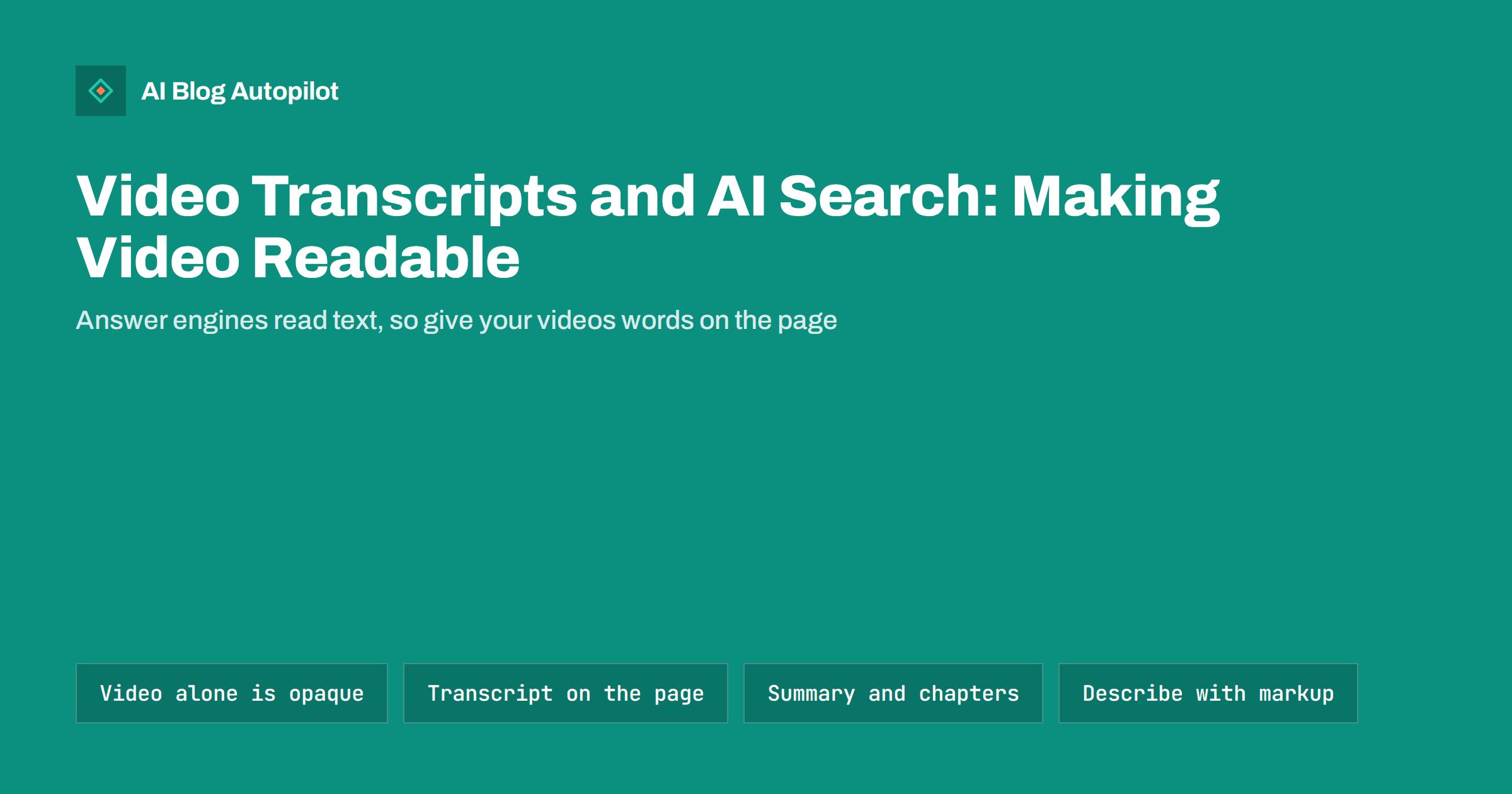
Short answer: AI answer engines mainly work with text. A video embedded on a blog post, with only a title and a sentence of description, gives them very little to find or quote, even if the video itself is excellent. Publishing an edited transcript on the page, adding a short written summary, splitting the content with headings or chapters, and describing the video with structured data turns spoken expertise into text that search engines, answer engines and readers can all use.
Many businesses put real effort into video: walkthroughs, interviews, webinars, explainers. Then they embed the video in a blog post with two lines of text and wonder why the post attracts little search traffic and never appears in AI-generated answers.
The reason is straightforward. The knowledge is in the audio track, and most of what search and answer systems read is the text on the page. This guide explains how to close that gap.
Why video alone is hard to cite
Search engines have become better at understanding video. They can read titles, descriptions, captions files and sometimes use automatic speech recognition. But several limits remain for a typical blog post with an embedded video.
- The embed is often a frame from another site. A video hosted on a video platform and embedded in your post lives on the platform’s page. Whatever the platform understands about it tends to be credited to the platform, not to your article.
- Speech is not structured. Even with an accurate automatic transcript, spoken content rambles, repeats and jumps between topics. It lacks the headings, lists and clear statements that make text easy to extract.
- Answer engines quote text. When an assistant builds an answer, it typically draws on passages of text. A spoken explanation that exists only as audio does not give it a passage to quote or a link to cite.
- Readers skim. Many people cannot or will not play a video: at work, on a train, with a slow connection or with a hearing impairment. Without text, the post gives them nothing.
None of this means video is a bad investment. It means video needs a written companion to be discovered and reused through text-based channels.
Transcript, captions and summary: three different things
These terms are often used interchangeably, but they serve different purposes.
- Captions are timed text that appears over the video while it plays. They help viewers who cannot hear the audio and are usually stored in a separate file, such as the WebVTT format.
- A transcript is the full text of what is said, presented as readable text on the page. It may be lightly edited for clarity.
- A summary is a short written version of the main points, usually a few paragraphs or a list, placed above or beside the video.
For discoverability, the transcript and summary on the page matter most, because they are ordinary HTML text. Captions matter for accessibility and help the video platform understand the content, and it is good practice to have all three.
Turning a raw transcript into readable text
An automatic transcript is a starting point, not a finished page. Spoken language carries filler words, false starts and phrases that make sense with a face and a tone of voice but not on paper. A little editing makes a big difference.
- Generate a draft transcript. Most video platforms and editing tools can produce one automatically.
- Fix names and terms. Speech recognition often mangles product names, technical terms and people’s names. Correct every one.
- Remove filler. Cut repeated words, “um” and “you know”, and false starts. Keep the speaker’s meaning and voice.
- Add paragraphs. Break the text wherever the topic shifts, so it does not appear as one long block.
- Add headings. A heading for each major topic in the video makes the transcript scannable and gives each section a clear label.
- Label speakers. In interviews and panels, name who is speaking at each change.
- Check facts. Things said casually on camera, like approximate numbers, deserve a quick check before they are published as text that others may quote.
A cleaned transcript does not need to be word for word. It should be faithful to what was said, but readable as text. If you edit substantially, you can call it an edited transcript.
Structuring the page around the video
The page that holds a video should work for three types of visitor: those who will watch, those who will read, and those who will skim for one answer. A structure that serves all three looks like this.
- A direct answer or summary at the top. Two to four sentences stating what the video covers and its main conclusion.
- The video. Embedded near the top, with a descriptive title.
- Key points or chapters. A short list of the topics covered, ideally with timestamps that match the video’s chapters.
- The transcript or a full written version. Organised with headings. On long videos, you can keep the transcript below the summary, but make sure it is present in the HTML when the page loads.
- Supporting material. Links, resources mentioned in the video, and an FAQ for follow-up questions.
For some videos, a rewritten article based on the video is better than a transcript. A webinar that wanders across several subjects can become a structured article with the video embedded as a companion, rather than a transcript that follows the wandering.
Hidden transcripts and collapsible sections
Some sites hide transcripts behind a “Show transcript” button to keep the page tidy. This is reasonable for readers, but pay attention to how it is built.
- Present in the HTML: if the transcript text is in the page source and only visually collapsed, search engines can generally read it.
- Loaded on click: if the text is fetched only when someone clicks the button, crawlers may never see it.
The safe choice is to include the text in the HTML and use collapsing only as a visual convenience. For your most important videos, consider showing the summary and headings openly and collapsing only the full verbatim text.
Structured data for videos
Structured data helps search engines understand that a page contains a video and what it is about. The relevant type is VideoObject, which describes the video’s name, description, thumbnail, upload date and duration, and can include a transcript and information about chapters.
- Use a real description. The description in the markup should say what the video covers, not repeat the title.
- Include the upload date and thumbnail. These are commonly required for video features in search.
- Mark up only the main video. If a page contains several videos, be clear which one is the main subject of the page.
- Keep it consistent with the page. Everything in the markup should match what visitors see.
Structured data does not guarantee any particular display in search results or in AI answers. It removes ambiguity about what the page contains, which is always worth doing. The text on the page still does most of the work.
Which videos deserve this treatment first
If you have a library of videos, you do not need to process all of them at once. Start where the effort pays back fastest.
- How-to and tutorial videos. People search for these tasks in text, and a written version of the steps is valuable on its own.
- Videos that answer common customer questions. These map directly to searches and to questions people ask assistants.
- Expert interviews. Interviews contain original insights that are not available elsewhere, which makes them strong citation material once written down.
- Webinars with evergreen content. A one-hour session can often become a full article and several shorter posts.
Videos about time-limited events or announcements are usually lower priority, unless they contain lasting information.
Accessibility is part of the same job
Transcripts and captions are not only about search. They make video usable for people who are deaf or hard of hearing, for people who process text better than audio, and for anyone in a situation where they cannot play sound. Accessibility guidelines treat text alternatives for audio and video as a basic requirement, and many organisations are expected to provide them.
Doing this work for accessibility and for discoverability at the same time is efficient: one cleaned transcript serves both. It also improves the experience for everyone who simply prefers to read.
How AI Blog Autopilot fits in
AI Blog Autopilot writes 2,000–3,000-word SEO articles with FAQ, tags and meta, publishes them to your WordPress blog and shares each one to your social networks. If your business produces videos, the topics and keywords behind them can also become written articles that stand on their own in search, and you can embed the matching video in the post in WordPress. The writer is instructed never to invent statistics, quotes or sources, so any quotes from your own videos should be added from your transcripts. You can see how it works on the AI Blog Autopilot home page.
Related reading
- Embedding Video in Blog Posts: When It Helps
- Accessibility for a Blog: The Fixes That Matter Most
- Repurposing an Article: One Piece, Several Formats
- Structured Data for a Blog: What Is Worth Adding
The bottom line
Answer engines and search engines read text far better than they understand speech inside an embedded player. If your expertise lives in video, give it a written form on the page: a short summary, clear chapters, a cleaned transcript present in the HTML, and accurate video markup. The same work makes your videos accessible and gives busy readers a way in, which is reason enough on its own.
FAQ
Do transcripts help videos appear in AI answers?
They make it possible for answer engines to work with the content, because the spoken information becomes text on the page that can be found and quoted. There is no guarantee of being cited, but a video without text gives answer engines very little to use.
Should I publish the full transcript or a summary?
Ideally both. A short summary at the top serves skimmers and gives a quotable overview, while the full, lightly edited transcript captures the detail. For long, wandering videos, a rewritten article can work better than a verbatim transcript.
Is an automatic transcript good enough?
It is a useful draft, but it usually needs editing. Correct names and technical terms, remove filler words, add paragraphs and headings, and check any figures mentioned in passing before publishing.
Can I hide the transcript behind a button?
Yes, as long as the text is present in the page HTML and only visually collapsed. If the transcript loads only after a click, search engines may not see it.
Do I need VideoObject structured data?
It is recommended for pages where a video is the main content, because it describes the video clearly to search engines. It does not replace the need for text on the page and does not guarantee any special display.