ENEnglish
 LTLietuviškai
 DEDeutsch
 FRFrançais
 RUРусский
 ESEspañol
 PLPolski
 ITItaliano
 UKУкраїнська
 CSČeština
 PTPortuguês
 JA日本語
JA日本語 LVLatviešu valoda
 ETEesti
 HUMagyar
 IDBahasa Indonesia
 TRTürkçe
 HIहिन्दी
 ELΕλληνικά
 ARالعربية
 THไทย
THไทย VITiếng Việt
 RORomână
 MSBahasa Melayu
 BNবাংলা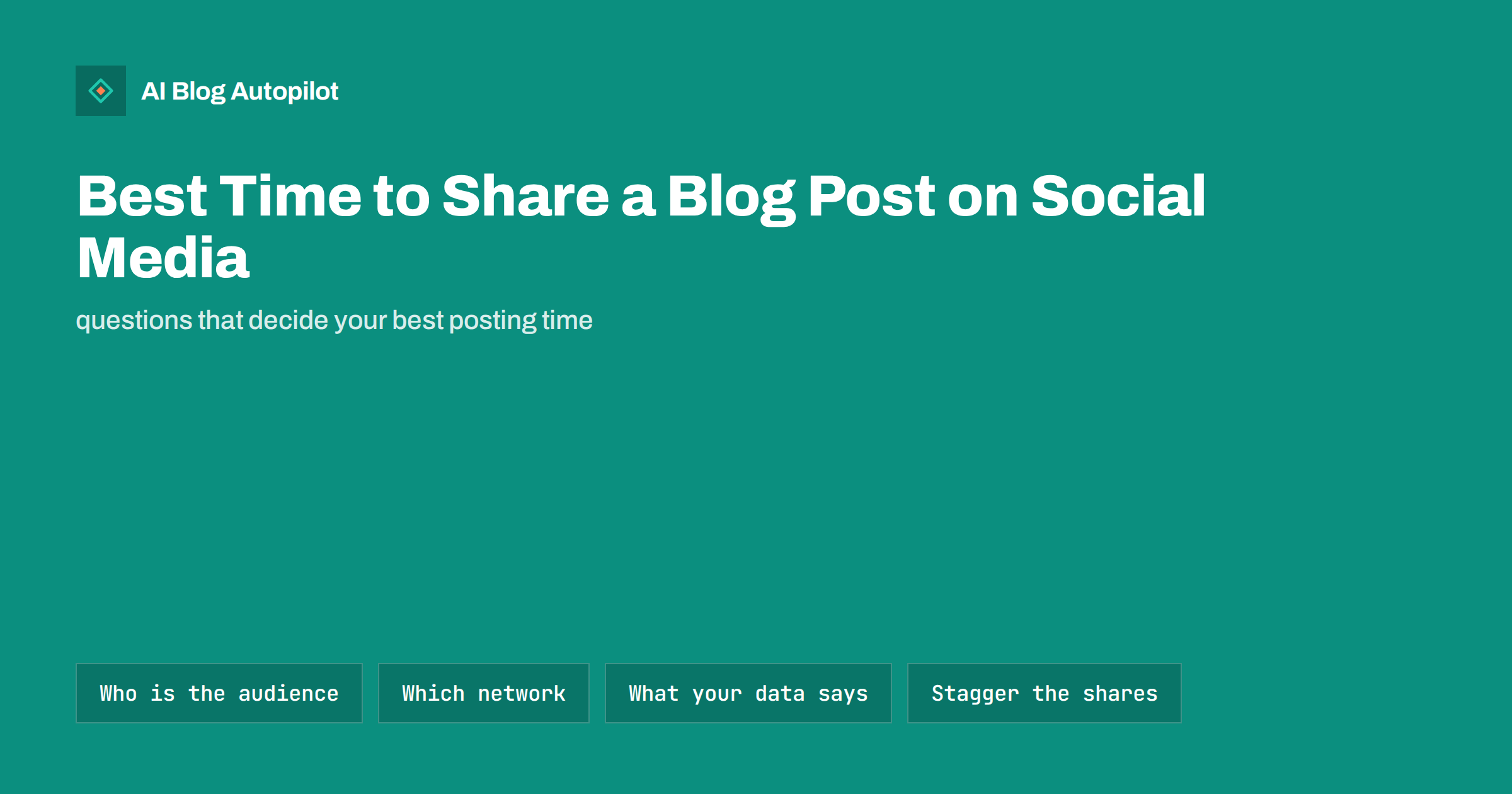
Short answer: there is no single best time to share a blog post that works for every account. The right time depends on when your particular audience is active on each network, which you can see in each platform’s own insights. As a starting point, business audiences are often most active on weekdays during working hours, and consumer audiences often in evenings and at weekends. Share at different times on different networks rather than everywhere at once, test for a few weeks, and let your own results replace any generic chart.
Search for “best time to post on social media” and you will find dozens of charts, each confidently naming a different hour. They cannot all be right, and for your account most of them are not, because they average millions of posts from accounts that have little in common with yours.
Timing does matter. A post shared when your followers are scrolling has a better chance of being seen than one shared while they sleep. But the answer comes from your own audience, not from a chart. This guide explains how to find it.
Why timing matters, and why it matters less than you think
Most social feeds are ranked by algorithms rather than shown strictly in time order, but recency is still one of the signals they use. A post that gets early engagement from people who are online when it appears is more likely to be shown to more people later.
That gives timing real value, especially for the first hour or so after sharing. It also explains the limits: a great post shared at an average time usually beats a weak post shared at a perfect time. Timing amplifies quality; it does not replace it.
Timing also matters differently by network. On fast-moving feeds, a post’s visibility is concentrated in the first hours. On networks where people search and save content, such as Pinterest, a pin can keep bringing visitors for months, and the exact posting time matters much less.
Start with your audience, not the network
Before looking at any data, answer three questions about your readers:
- When do they have time? Office workers often check professional networks during the working day. Parents, shift workers and hobbyists may be most active in evenings or at weekends.
- Where are they? If your audience spans several time zones, a single “best hour” does not exist. Consider the zone where most of your readers are, or share more than once at different times.
- Is your content work or leisure? A guide to tax deadlines is read at a desk. A recipe or a travel guide is read on a sofa. Share accordingly.
These answers already narrow the options more than any generic chart. If you are unsure, ask: a short poll or a question to existing customers about when they usually read industry content can be surprisingly revealing.
General patterns by network
With the caution that every audience is different, some patterns are widely observed and make reasonable starting points:
| Network | Typical starting point | Notes |
|---|---|---|
| Weekday mornings and lunchtimes | Professional audience; weekends are usually quieter | |
| Weekday late mornings to early afternoons, some evenings | Varies widely between business pages and communities | |
| Lunchtimes and evenings | Consumer audiences are often active outside work hours | |
| X | Weekday mornings, around news cycles | Fast feed; visibility fades quickly |
| Evenings and weekends | Pins are long-lived, so exact timing matters less | |
| Telegram and similar channels | When subscribers expect updates | Consistency matters more than the hour |
Treat this table as a hypothesis to test, not a rule. Your audience may behave very differently.
Use each network’s own insights
Most major networks show business accounts when their followers are online and how individual posts performed. This is far more relevant than any published chart, because it is about your followers.
- Look for “when your followers are active” or similar charts in the account’s analytics or insights section, where available.
- Review past posts sorted by reach or engagement. Note the day and time of the best and worst performers.
- Check your website analytics for social referral traffic by hour and day. This shows when shared links actually bring visitors, which is the result you care about.
If your account is new or small, the data will be noisy. In that case, start with the general patterns above and let data accumulate before drawing conclusions.
Stagger shares instead of posting everywhere at once
A common habit is to publish a post and share it to every network in the same minute. It is convenient, but it wastes an opportunity.
Each network’s audience is online at different times, and people who follow you in several places see the same link repeatedly within minutes. Spreading shares out solves both problems. For example: publish the article at your chosen hour, share it to LinkedIn shortly after, to Facebook a couple of hours later and to Pinterest the next day.
Staggering also lets you adapt the text for each network. A LinkedIn post can lead with a professional takeaway; an Instagram caption can focus on a practical tip; a pin needs a descriptive title that works in search.
How to test your timing
A simple, honest test takes a few weeks:
- Pick two or three time slots per network based on your audience and insights.
- Rotate them across similar posts for three to four weeks, so each slot gets several posts.
- Record the same metrics for each post: reach or impressions, engagement and link clicks, measured at the same point, such as 48 hours after sharing.
- Compare averages, not single posts. One viral post can distort any comparison.
- Keep the winner and test a new challenger slot in the next round.
Keep the test simple enough that you will actually finish it. A shared spreadsheet with one row per post and columns for network, day, time, reach, engagement and clicks is enough. Automated tools can export some of this, but even manual notes over a month reveal patterns that no generic chart can.
Be aware that other factors vary too: the topic, the image, the day’s news. That is why several posts per slot matter more than precise measurement.
Common timing mistakes
A few habits undermine even well-chosen posting times:
- Copying a chart without checking. A published “best time” is an average across very different accounts. Use it to choose what to test, not as a final answer.
- Ignoring your own time zone settings. Scheduling tools and platforms sometimes use different time zones. A post meant for 9:00 local time can quietly go out at 9:00 somewhere else.
- Judging from one post. A single post that did well at an odd hour proves little. Look at averages across several posts.
- Posting only when it suits you. Sharing late at night because that is when you finish work may mean most followers see the post the next day, buried under newer content.
- Forgetting holidays and events. Public holidays, major sports events and news days change when people scroll. Adjust around them for important posts.
- Never revisiting. Audiences change as an account grows. A timing test from two years ago may no longer reflect who follows you now.
Frequency and resharing
Timing and frequency interact. Sharing a new article once, at a good time, is the minimum. Many articles deserve more than one share over their lifetime:
- A second share a few days later, at a different time, reaches followers who missed the first.
- Evergreen reshares of useful older articles, spaced weeks or months apart, keep good content working long after publication.
- Different angles for each reshare, such as a new quote, a different tip or a question, keep repeated shares from feeling like spam.
The right frequency depends on the network and on how much you publish. A reasonable principle: share often enough that followers see your best work, and never so often that your posts feel like background noise.
How AI Blog Autopilot schedules shares
AI Blog Autopilot publishes each article to your blog at the hour you choose and then shares it to your social networks with its own text, length and time for each one. In AUTO mode, the timing per network is staggered, for example LinkedIn about 30 minutes after the blog, Facebook after two hours and Pinterest the next day. The Growth plan and above also include evergreen reshares of older articles. You can see what each plan includes on the pricing page.
Related reading
- Turning an Article Into Social Posts That Get Read
- Auto-Post Every New Blog Article to Social Media Automatically
- Using LinkedIn to Distribute a Business Blog
- Open Graph Tags: Controlling How Shared Posts Look
The bottom line
The best time to share a blog post is when your own audience is active on that particular network, and only your data can tell you exactly when that is. Start from what you know about your readers and the general patterns for each network, stagger shares rather than posting everywhere at once, test a few slots for several weeks and keep what works. Then spend the time you saved on making the posts worth seeing.
FAQ
What is the best time to post a blog link on social media?
There is no universal best time. It depends on when your audience is active on each network. Business audiences are often active on weekday mornings and lunchtimes, consumer audiences often in evenings and at weekends. Check each network’s insights and test to find your own times.
Should I share a new blog post on all networks at the same time?
Usually not. Each network’s audience is online at different times, and people who follow you in several places see the same link repeatedly. Staggering shares over hours or a day reaches more people and lets you adapt the text for each network.
How can I find when my followers are online?
Many networks show business accounts when their followers are active in the insights or analytics section. You can also review past posts by performance and check social referral traffic by hour in your website analytics.
How many times should I share the same blog post?
Share a new post once on each relevant network, then consider a second share a few days later at a different time. Useful evergreen posts can be reshared every few weeks or months with a fresh angle, as long as it does not feel repetitive.
Do time zones matter for social media posting?
Yes, if your audience is spread across regions. Schedule for the time zone where most of your readers are, or share important posts more than once so that followers in different regions see them at a convenient time.
Does posting time matter on Pinterest?
Less than on most networks. Pins are found through search and boards for a long time after they are posted, so the exact hour matters much less than a clear title, a good image and a relevant description.