ENEnglish
 LTLietuviškai
 DEDeutsch
 FRFrançais
 RUРусский
 ESEspañol
 PLPolski
 ITItaliano
 UKУкраїнська
 CSČeština
 PTPortuguês
 JA日本語
JA日本語 LVLatviešu valoda
 ETEesti
 HUMagyar
 IDBahasa Indonesia
 TRTürkçe
 HIहिन्दी
 ELΕλληνικά
 ARالعربية
 THไทย
THไทย VITiếng Việt
 RORomână
 MSBahasa Melayu
 BNবাংলা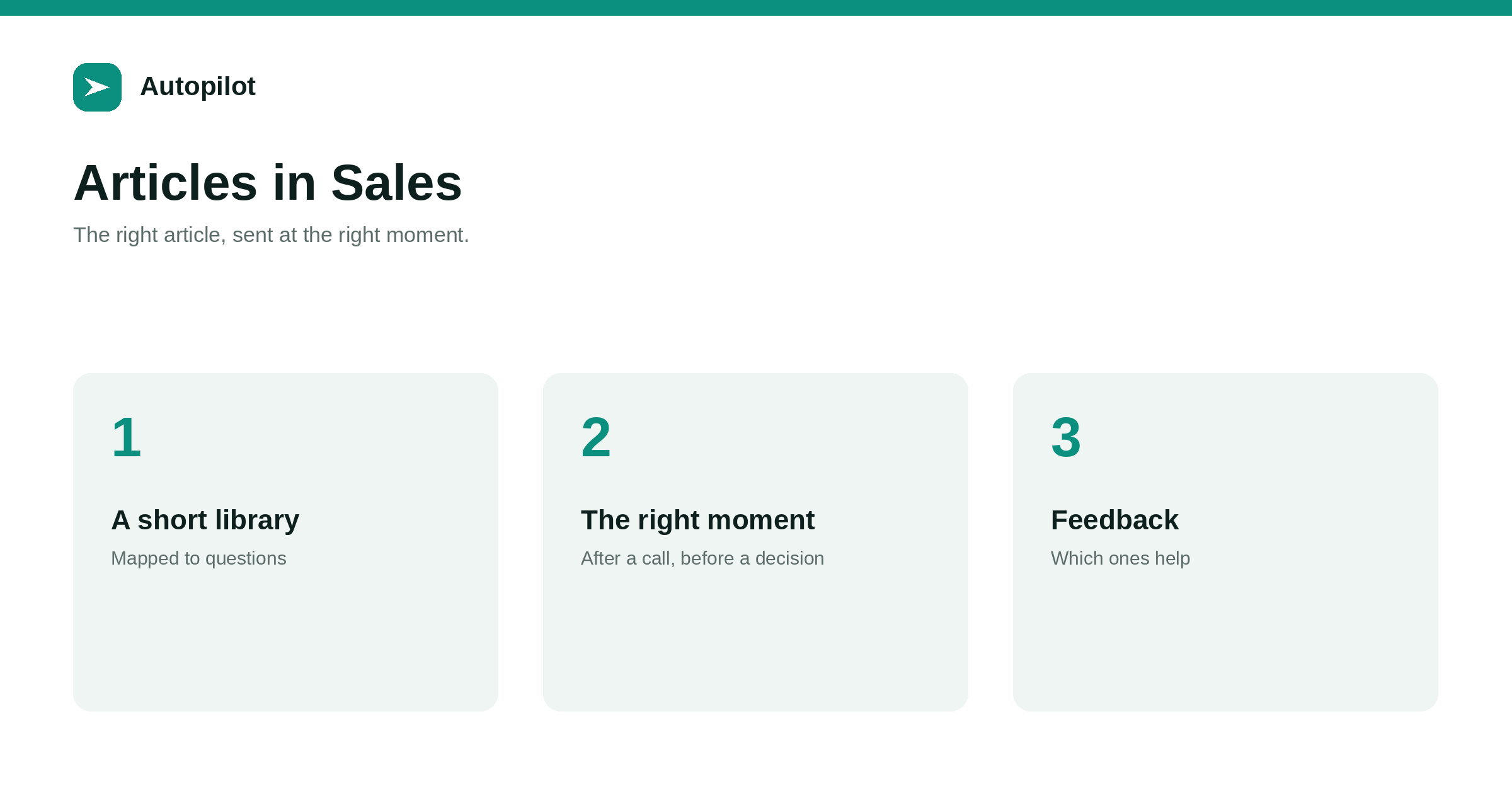
Short answer: build a short library of the articles that answer the questions prospects ask most, grouped by question and by stage, and give it to the sales team. Encourage them to send a relevant article after a call, in reply to an objection, or to help a champion convince colleagues, with a sentence explaining why it is relevant. Ask sales which articles help and which questions have no good article, and feed that back into planning. Count articles used in deals as part of the blog’s value, since analytics rarely captures it.
Many business blogs are written by marketing and ignored by sales. Salespeople answer the same questions by email every week, unaware that a thorough answer already exists on the blog.
Connecting the two is one of the cheapest ways to get more value from content that already exists, and it often shows the blog’s value more clearly than any traffic report.
Why articles help in sales
A good article does things an email cannot. It answers the question thoroughly, it shows the business knows its subject, it can be forwarded to colleagues, and it carries more weight than a salesperson’s assertion because it is written for everyone, not just this prospect.
It also saves the salesperson time, which is the argument that usually wins them over.
Build a short library
Ask the sales team for the ten questions prospects ask most, and the objections that stall deals. For each, find the best existing article, or note that none exists.
| Question or objection | Article | Stage |
|---|---|---|
| How much time will this take us? | A realistic time and effort article | Evaluating |
| How does it compare with hiring? | A fair comparison | Evaluating |
| Is it safe to connect to our site? | A connection and access guide | Deciding |
| What if the output is wrong? | An article on review and limits | Deciding |
| What happens if we cancel? | Terms or a clear FAQ | Deciding |
Keep the library short enough that salespeople remember it. Twenty articles used is worth more than two hundred ignored.
Sending the right article
Timing matters. Useful moments include after a first call, to confirm and extend what was discussed; in reply to a specific objection; and when a champion needs material to persuade colleagues — content for a buying committee.
Add a sentence explaining why the article is relevant: you asked about review time; this covers what most teams find. A bare link reads as a brush-off.
Filling the gaps
Questions with no good article are the most valuable topics you can write about: they come from real prospects close to buying. Add them to the plan with high priority.
finding the gaps in your blog covers collecting questions; sales is often the richest single source.
Articles that work particularly well
Some formats are especially useful in sales: honest comparisons, cost and effort explanations, case studies — writing a case study — answers to objections, and clear guides to setup and security.
They share a quality: they answer the question a prospect has at the moment of deciding, honestly, including limits.
Keeping sales informed
Tell the sales team when new articles relevant to their conversations are published, briefly: the question it answers and one line on when to use it. A short monthly note is enough.
Feedback and measurement
Ask sales regularly which articles help, which prospects mention, and which do not land. That feedback improves articles and shows which formats work.
Record articles used in deals as part of the blog’s contribution. Analytics rarely captures a link sent by email and read by a buyer’s colleague, but it may be where the blog does most of its work — measuring whether a blog is working.
Writing with sales in mind
Some articles can be planned specifically for sales use: answers to objections, cost explanations, and guides to what implementation involves. Write them for the prospect, not for the salesperson, and keep the tone the same as the rest of the blog. An article that reads like a sales pitch is less persuasive than one that reads like honest advice.
Involve a salesperson in reviewing these articles. They know which phrasings prospects respond to and which objections the article must address.
Making articles easy to send
Salespeople send articles from email and messaging tools, often on phones. Short, descriptive URLs and clear titles make articles easy to share and easy for recipients to recognise. A summary at the top helps the recipient decide quickly whether to read.
A shared list of the library’s links, with a one-line description of each, lets a salesperson find the right one in seconds during a busy day.
Avoiding overload
Sending five articles at once overwhelms a prospect. One well-chosen article with a sentence of context is more likely to be read than a list. If several are relevant, send the most important and mention the others are available.
Training new salespeople
The sales library doubles as training material. New salespeople who read it learn the questions prospects ask, the honest answers, and the language the business uses, which shortens their ramp-up and keeps messaging consistent across the team.
A monthly check-in
Fifteen minutes a month between whoever plans content and a salesperson is enough: which articles were sent, which helped, which questions had no good article, and what new objections have appeared. That short conversation often produces the next month’s most valuable topics.
When prospects find articles themselves
Some prospects arrive at a sales call having already read several articles. Ask which ones; it shows what they care about and saves repeating what they already know.
Keeping articles accurate
An article sent by sales must be accurate and current. Outdated pricing or features in an article sent to a prospect creates confusion at the worst moment.
Review sales-library articles more often than others, and link to live pricing rather than stating figures.
Related reading
If this was useful, these cover the questions that usually come next.
- Content for a buying committee — articles for each person involved
- Writing a case study — one of the most useful sales articles
- Measuring whether a blog is working — counting this contribution
The bottom line
Build a short library of articles answering the questions and objections prospects raise, grouped by stage, and give it to sales. Send articles with a sentence of context at the right moments, turn unanswered questions into new articles, keep sales informed of new ones, ask what helps, and count sales use as part of the blog’s value.
FAQ
How can sales teams use blog content?
By sending relevant articles after calls, in reply to objections, and to help internal champions persuade colleagues.
Which articles are most useful in sales?
Honest comparisons, cost and effort explanations, case studies, answers to objections, and setup and security guides.
How big should a sales content library be?
Small enough to remember, often around twenty articles mapped to common questions.
How do I find out what sales needs?
Ask for the ten most common questions and the objections that stall deals.
Should salespeople add a note when sending articles?
Yes, a sentence explaining why the article is relevant to the prospect’s question.
How do I measure articles used in sales?
Ask sales and customers which articles helped, and record their use in deals alongside analytics.