ENEnglish
 LTLietuviškai
 DEDeutsch
 FRFrançais
 RUРусский
 ESEspañol
 PLPolski
 ITItaliano
 UKУкраїнська
 CSČeština
 PTPortuguês
 JA日本語
 LVLatviešu valoda
 ETEesti
 HUMagyar
 IDBahasa Indonesia
 TRTürkçe
 HIहिन्दी
 ELΕλληνικά
 ARالعربية
 THไทย
 VITiếng Việt
 RORomână
 MSBahasa Melayu
 BNবাংলা
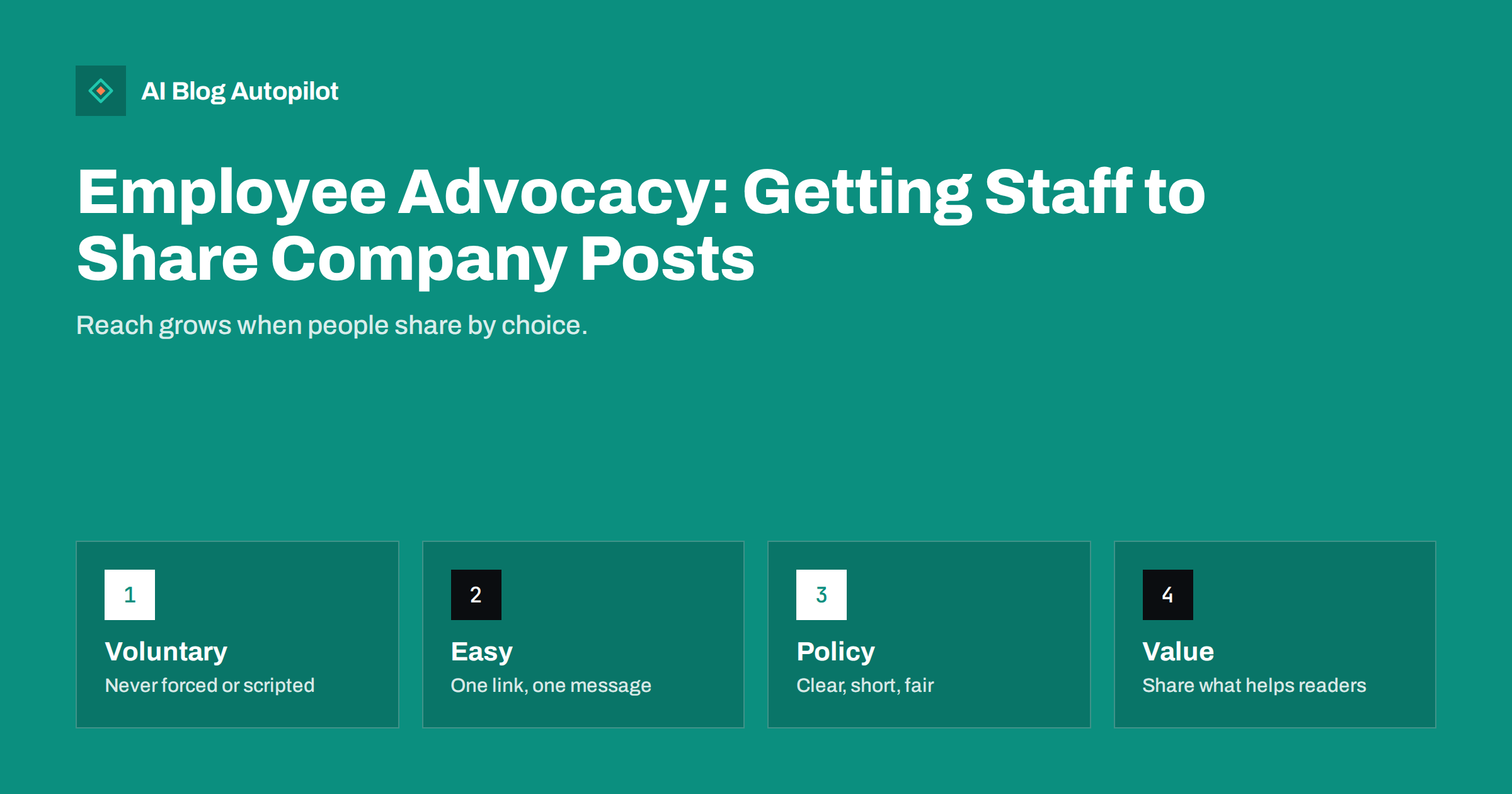
Short answer: employee advocacy means staff choose to share your company’s posts on their own profiles. It works when sharing is voluntary, easy and useful to their own network, and when a short, fair policy explains what is welcome. Forced sharing, identical captions and rewards for volume usually backfire.
People trust people more than logos. A post from a colleague about something interesting at work often receives more attention from friends and contacts than the same post from the company page. That is why many businesses want their teams to share, and why many of those attempts fail.
This guide explains how to start an advocacy habit without pressure: what to share, how to make it easy, how to write a policy, how to measure results and which mistakes to avoid. It suits small and medium businesses as well as larger ones, since the principles do not depend on size.
Why staff sharing helps
Employees are connected to people who rarely follow a company page: friends, former colleagues, suppliers, neighbours and people in the same profession. A post shared by an employee reaches those people with a personal introduction, which is a different thing from a paid advertisement.
Sharing also helps recruiting. People considering a job look at what current staff say about the workplace. When employees share projects and achievements in their own words, candidates see a real culture behind the job description.
There is an internal benefit too. Staff who share useful posts learn more about what the business publishes and why. They are better prepared to answer questions from customers and feel that they belong to something worth showing. Do not expect miracles; treat advocacy as a modest addition to your other efforts, not a replacement for them.
Keep it voluntary
The single most important rule is that sharing must be a choice. Staff have private lives and personal accounts, and not everyone wants to mix them with work. Pressure creates resentment, and employees who feel forced often post in ways that look stiff or insincere.
Make it clear that there is no penalty for not sharing and no reward for volume. Thank people who join in, but do not rank them on a public leaderboard. Some will share regularly, some occasionally and some never, and all three are fine.
Respect people’s right to opt out of being featured. Not every employee wants their photograph on the company account. Ask before tagging or posting, and check that anyone shown in an image has agreed. Keep a written record of permissions, and see original photos on a blog for related habits.
Share what is worth sharing
Staff will only share content that they find interesting or useful. A post that reads as an advertisement rarely gets shared, while a practical guide, a behind-the-scenes story or a piece of good news often does. Ask yourself: would I share this on my own profile if I did not work here?
Offer variety. Include helpful articles from your blog, news about customers and projects (with permission), team stories, job openings and industry insights. Avoid sending a stream of promotional posts. A mix of two or three useful items per week is more welcome than a daily request.
Let people add their own words. A short personal comment, such as why the topic matters to them, makes a shared post feel real. Identical captions copied by twenty people are easy to spot and make everyone look like a bot. The article on turning blog posts into social posts gives ideas for different angles.
Make sharing easy
If sharing takes ten steps, few people will do it. Send a short message, perhaps in a team chat or an email, with the link to the post and a suggested line they can change. Keep a shared page or channel where the latest items are listed, so nobody has to search for them.
Choose the networks that suit your staff. Many professionals use LinkedIn, but others may prefer a different network, and the right place depends on your audience. Do not insist on a platform people do not use.
Think about timing. Share the company post first, then ask staff to follow within a day or so, which gives their contacts a chance to see it on the original page. Avoid sending requests late in the evening or during busy periods. A short, calm message once or twice a week is plenty.
Explain the purpose in one honest sentence when you invite people: “we would like more people to see our work, and your own network is the best place for it, if you are happy to help”. Plain reasons are respected more than slogans, and they leave room for people to decline without awkwardness.
Write a short, fair policy
Staff need to know what is expected. A one-page social media policy should state what may and may not be shared, which information is confidential, how to speak about customers and competitors and what to do if someone posts something negative about the business. Write it in plain language, not legal jargon.
Include clear guidance on disclosure. If an employee shares a company post, their connection to the company is obvious, but if they promote products in a way that looks independent, rules in many countries require them to say so. Remind staff to be honest and clear. The guide to disclosure covers a similar principle.
Explain what happens if something goes wrong. A mistake, such as a post with a wrong detail, should be handled with calm correction, not blame. Make sure that someone is responsible for answering questions about the policy, and review it once a year.
Respect privacy and security
Sharing connects work and personal accounts, so security matters. Remind staff to use strong, unique passwords and two-step verification, and to keep personal and company accounts separate. Never ask anyone to share their login with the company. The guide to securing social media accounts lists the steps.
Warn people about oversharing. Photographs of screens, desks or documents can show confidential information. A badge or a visitor list in the background of a picture may reveal more than intended. A short checklist before posting avoids most problems.
Be careful with sensitive topics. Staff should not speak on behalf of the company in a crisis or on controversial subjects unless they have agreed to do so. Provide a clear contact for press and customer questions, so that employees can refer them on.
Run a small pilot first. Choose one month, invite a handful of volunteers, share two or three posts a week and note what happens. Ask the volunteers what felt natural and what felt forced. A pilot costs almost nothing, shows whether the idea suits your business and gives you real examples to show colleagues who are unsure.
Measure without spying
Track the effect of advocacy through the company’s own analytics. Use links with tracking tags to see visits from shared posts, and look at the number of shares, comments and enquiries. The article on UTM tags for social shares explains the setup.
Do not monitor individual employees’ personal accounts. Tracking who shared what, and when, damages trust, and it may be restricted by privacy rules. Look at totals and trends instead, and share them with the team so that they see the result of their effort.
Ask for feedback. Which posts did people like to share? Which felt awkward? A quick survey every few months shows what to change, and it signals that you take their view seriously.
Think about the different kinds of sharing and match them to people. A technical expert may share a detailed guide with peers, a salesperson may pass on a customer story, and a manager may highlight a job opening. Let each person choose the kinds of post that fit their own role and voice. This also keeps feeds varied, which makes each share look more genuine.
Give staff a way to suggest content. Some of the best posts come from the people who see the work: a photo from a job, a milestone reached, a customer who said something kind. Set up a simple channel for such ideas, check consent, and credit the person who suggested them. People share more readily when they have helped to create what they share.
Consider onboarding. New employees often like to introduce themselves, and a short, friendly welcome post can be a good first act of advocacy, if they want to do it. Offer it as an option and do not announce anyone without permission.
Common mistakes to avoid
The first mistake is turning advocacy into an obligation. The second is flooding staff with requests. The third is giving everyone the same words to post. The fourth is rewarding the number of shares, which encourages low-quality sharing. The fifth is ignoring the comments that follow: if staff share and nobody replies, interest fades.
Another mistake is starting with a big programme. Begin with a small group of keen volunteers, learn what works and expand slowly. A few people who share well do more good than a crowd who share reluctantly.
Finally, remember that advocacy only works when the content is good. If your blog and social posts are thin, no amount of sharing will help. Focus on publishing useful articles first, and sharing becomes natural.
Recognise effort in a low-key way. A simple thank-you in a team meeting, a mention in the internal newsletter or a note from a manager is enough. Avoid prizes tied to numbers of shares, since these push people to share anything, and keep the focus on the quality of what is passed on.
How AI Blog Autopilot helps
A steady flow of useful articles gives your team something worth sharing. AI Blog Autopilot writes and publishes articles and shares each one to your social networks automatically, so staff always have fresh posts to pass on. See the pricing page for plans.
Related reading
The bottom line
Make staff sharing voluntary, easy and useful, write a short and fair policy, protect privacy, measure totals and start small with people who want to take part.
FAQ
What is employee advocacy?
It is when staff choose to share company posts and content on their own social profiles to reach people who may not follow the company.
Should employees be required to share company posts?
No. Forced sharing leads to resentment and stiff, insincere posts. Keep it voluntary and thank those who take part.
Do we need a social media policy?
Yes, a short, plain one that covers confidentiality, disclosure, customers, competitors and what to do if something goes wrong.
How do we measure results?
Use tagged links and company analytics to see visits, shares and enquiries. Do not monitor individual staff accounts.
How often should we ask staff to share?
Once or twice a week at most, with a mix of useful, non-promotional content.